Suriname to Pump First Deepwater Natural Gas by 2030
Block #9
Suriname to Pump First Deepwater Natural Gas by 2030
In 4 slidesThe gist of this article, fast
- 01
Suriname to pump first deepwater natural gas by 2030
A €1.46 billion investment will bring the Sloanea gas field online via a floating LNG facility as the debt-laden country seeks financial relief.
BLOCK #9 · block9.net - 02
Suriname seals €1.46 billion offshore gas deal
Petronas and Staatsolie approved the KrakaWi project in Block 52. First gas from the Sloanea field is scheduled to flow in mid-2030.
BLOCK #9 · block9.net - 03
Floating facility replaces subsea pipelines
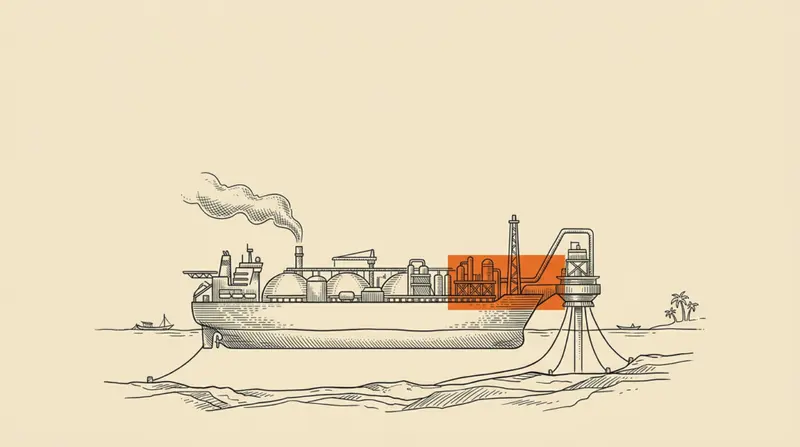
Rather than building pipes to the coast, an offshore FLNG unit will liquefy the gas at sea. Tankers will ship cargoes directly to global buyers.
BLOCK #9 · block9.net - 04
Output will hold steady for 25 years
Staatsolie director Annand Jagesar expects production to hold a stable plateau for at least 25 years, providing long-term revenue to ease public debt.
BLOCK #9 · block9.net
A €1.46 billion investment will bring the Sloanea gas field online via a floating LNG facility as the debt-laden country seeks financial relief.
At the presidential palace in Paramaribo, President Jennifer Geerlings-Simons and Tengku Muhammad Taufik, chief executive of Malaysia's state-owned energy giant Petronas, unveiled a blueprint intended to bolster Suriname's public finances for decades to come. Both parties sealed the final investment decision for the KrakaWi offshore development in Block 52, which will see Suriname extract commercial natural gas from deep waters for the very first time in its history. Total capital expenditure for the venture stands at $1.6 billion, or approximately €1.46 billion. According to current timelines, the first cubic metre of gas is scheduled to flow mid-2030. The name KrakaWi combines the local Sranan Tongo terms for support and we, a deliberate nod to the catalytic role the extraction is intended to play in lifting the domestic economy.
The development centres on the substantial Sloanea field, where geological estimates by Petronas indicate nearly 113.3 billion cubic metres of natural gas in place. According to present models, at least half of these reserves can be recovered commercially and directly. State-owned oil company Staatsolie is taking a 20 per cent stake in the consortium via a subsidiary, committing $320 million, or more than €292 million. Petronas will hold the remaining 80 per cent and assume operatorship. Rather than laying extensive subsea pipelines to the coast, the partners opted for an offshore floating unit that liquefies the produced gas on site into LNG. These liquefied cargoes will then be shipped directly by tanker to destination markets across the globe.
Floating units and stable revenue streams at sea
Opting for a floating production facility, known in industry parlance as a floating liquefied natural gas unit (FLNG), lowers the threshold for Suriname to secure swift access to global energy markets. Ocean-going transport removes the immediate necessity of erecting heavy industrial processing infrastructure onshore, though the door remains open for an offshore pipeline link to the mainland further down the line. Annand Jagesar, managing director of Staatsolie, noted that natural gas offers a valuable counterweight to the volatility of the oil market. While crude oil fields typically face a sharp peak followed by steep declines in production profiles, KrakaWi's gas output can be maintained at a relatively stable plateau for at least 25 years.
This stability is essential for the country's long-term domestic energy security. Jagesar pointed out that Staatsolie wants to prepare for a scenario where part of the gas is eventually brought ashore. That would allow Suriname to transition its domestic power generation away from polluting heavy fuel oil toward natural gas, cutting emissions while improving the reliability of electricity supplies for local households and businesses. Even so, the lion's share of production in the opening phase will be earmarked for export. The foreign currency revenues generated are expected to address a structural shortfall in the South American nation's public finances.
Annand Jagesar, managing director of Staatsolie, noted that natural gas offers a valuable counterweight to the volatility of the oil market.
The backdrop of multi-billion-dollar deals off the Surinamese coast
The Block 52 agreement does not come in isolation, but builds upon a string of earlier discoveries across the Guyana-Suriname basin. This shared maritime frontier has emerged over recent years as one of the world's most prolific new oil and gas frontiers, ignited by ExxonMobil's massive discoveries in neighbouring Guyana. Suriname has long sought to capture that same wave of prosperity. A crucial milestone came in October 2024, when France's TotalEnergies and US-based APA Corporation, alongside Staatsolie, took the final investment decision for the GranMorgu project in Block 58. That development requires an investment of at least $12 billion, or nearly €11 billion, with production targeted to start mid-2028.
Comparing the headline figures reveals how both projects complement one another while operating on entirely different scales. At €1.46 billion, the KrakaWi gas project requires roughly one-eighth of the capital deployed for GranMorgu, lowering the financial barriers to entry for Staatsolie accordingly. While the billions poured into GranMorgu's crude oil are intended to generate rapid, maximised export revenues, the gas field provides a more predictable, defensive cash flow. Contracts for Block 52 were signed years ago, but Petronas required confirmed appraisal drilling results and favourable market dynamics before definitively committing billions in capital.
Historical links and the impact on Belgian and Dutch readers
For observers in Belgium and the Netherlands, this shift in Paramaribo goes beyond standard international energy reporting. The deep historical, familial and economic ties linking the Netherlands and Suriname mean that financial shifts in the country reverberate across the Low Countries. Hundreds of thousands of Dutch citizens with Surinamese heritage regularly send remittances to relatives to help cushion high living costs and the pressure on the local currency. If Suriname succeeds in systematically replenishing its treasury with oil and gas revenues from 2028 and 2030 onwards, that windfall could stabilise the exchange rate and lessen the burden of private financial support from Europe.
At the same time, the development intersects with European energy security and port infrastructure. Since the curtailment of large-scale Russian pipeline deliveries, European member states, including the Netherlands and Belgium via LNG terminals in Rotterdam and Zeebrugge, have been seeking reliable LNG suppliers. A new exporter in the Caribbean-Atlantic basin widens the pool of supply in the global market. Furthermore, Dutch and Belgian maritime contractors, dredging specialists and engineering firms possess niche expertise in offshore infrastructure, unlocking commercial opportunities around the construction, installation and maintenance of offshore facilities and future coastal pipelines.
Balancing debt pressures and environmental protection
The pace at which Suriname is welcoming foreign energy majors is closely tied to the burdensome economic inheritance weighing on the state. Paramaribo faces substantial sovereign debt obligations, including debts held with the International Monetary Fund and bilateral creditors such as China. This debt load has constricted the national budget for years, curbing public capital spending on education, healthcare and infrastructure. In our assessment, this economic necessity has compelled the Geerlings-Simons administration to grant concessions to multinationals swiftly, even as domestic institutions remain in the process of building capacity to oversee multi-billion-euro financial flows.
This is precisely where friction points emerge, as the United Nations recently underscored in a critical assessment of resource extraction plans across the region. The UN explicitly warned of the risks linked to the resource curse: severe environmental degradation in vulnerable marine ecosystems, alongside a widening wealth gap between the narrow group benefiting from the energy sector and the wider population. During the press conference, President Geerlings-Simons stressed that Petronas must deliver on local employment. Currently, barely fifteen Surinamese nationals are employed by the Malaysian state enterprise. Training local technical and managerial personnel will be crucial if the country is to avoid remaining a passive bystander while foreign corporations extract its natural resources.
What the newsroom is watching in the years ahead
The decision to develop KrakaWi marks a strategic shift, but an investment decision on paper does not guarantee smooth delivery by 2030. In our view, the tangible benefits for Surinamese citizens will hinge on how effectively the government captures and manages resource revenues through a sovereign wealth fund designed for future generations. Without a transparent legislative framework, there is a distinct risk that proceeds could leak away into debt service rather than generating durable prosperity.
Moving forward, we will be closely monitoring the contract awards for the construction of the floating LNG unit and the precise terms under which Staatsolie finances its €292 million commitment. Whether Petronas fulfils its pledge to train and upskill a local workforce will also serve as a key barometer of social acceptance. Suriname stands on the cusp of transitioning from a vulnerable, commodities-dependent economy into a fully fledged offshore energy producer, but the journey to first gas in just over four years remains lined with technical, financial and ecological hurdles.
- Aardgas
- energy
- LNG
- Offshore
- Paramaribo
- Petronas
- Staatsolie
- Suriname
- TotalEnergies
- Zuid-Amerika
Written by
Veerle Janssens
Institutional Editor · Bruges (BE)
Expertise
Veerle spoke with asset managers and pension funds for years. She writes about institutional adoption, custody, and risk management.
Stay in the loop
Follow Block #9.
Daily market and equity news in your feed. Follow us on Facebook and Instagram so you never miss an analysis.
Practice without real money or test your knowledge?
Read more
Other interesting articles

Miners Hoped for Lasting Relief, but Bitcoin Mining Difficulty Climbs 7.61%
- 02Modivo Clears Its Warehouses and Sees Market Value Rise 5%

- 03Belgian Federal Government Extends Transitional Scheme for Unemployed Family Carers

- 04WiseTech Surges 16.7% as Full-Year Guidance Maintained and Cost Savings Accelerate

- 05Javier Milei Promised To Abolish The Central Bank But Now Shackles It By Law