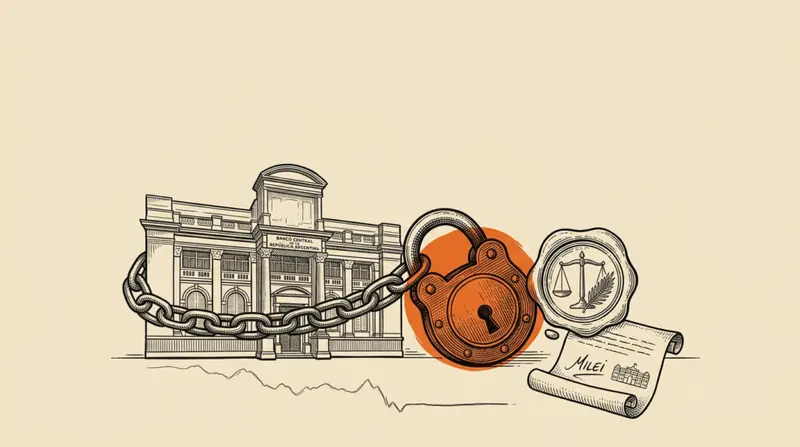
Javier Milei Promised To Abolish The Central Bank But Now Shackles It By Law
Block #9
Javier Milei Promised To Abolish The Central Bank But Now Shackles It By Law
In 4 slidesThe gist of this article, fast
- 01
Javier Milei promised To abolish The Central Bank but now shackles it by law
The Argentine Congress grants final approval to a reform curbing government borrowing from the central bank and restricting its mandate to price…
BLOCK #9 · block9.net - 02
Congress locks the central bank printing press
The Chamber of Deputies gave final approval to Javier Milei's bill. The reform prevents the treasury from plugging budget deficits with freshly printed pesos.
BLOCK #9 · block9.net - 03
A clean break from the 2012 mandate
Argentina scrapped the dual mandate introduced in 2012 under Cristina Fernández de Kirchner. The bank no longer pursues employment or social redistribution targets.
BLOCK #9 · block9.net - 04
Presidents lose decree power over bank leaders
The head of state can no longer dismiss board members by decree. Any future appointment at the helm of the central bank will require an absolute majority in the Senate.
BLOCK #9 · block9.net
The Argentine Congress has granted final approval to a reform curbing government borrowing from the central bank and restricting its mandate strictly to price stability.
In the corridors of Congress in Buenos Aires on Thursday evening, relief prevailed across the governing coalition after the Chamber of Deputies gave final approval to President Javier Milei's bill. The Senate had previously greenlit the plan, which makes it significantly harder for the Ministry of Economy to continue plugging budget deficits with freshly printed pesos. While Milei vociferously pledged during his election campaign to blow up the central bank, in legislative practice he has opted instead to place the institution on a much tighter leash. The monetary spigot to the treasury is being turned off in an effort to halt the chronic currency depreciation that has plagued the South American nation for decades.
A Legal Lock On The Argentine Printing Press
The approved reform directly amends the official charter of the Banco Central de la República Argentina. From now on, the statute mandatorily dictates that the supervisory authority may focus exclusively on monetary and financial stability. The government thereby loses its long-standing back door to force loans from its own central bank whenever revenue from taxes lags behind state expenditure.
Lawmakers also curtailed the direct grip of the head of state over the institution's leadership. A sitting president can no longer unilaterally appoint or dismiss the governor and board members by decree. Any future appointment at the helm of the central bank will henceforth require an absolute majority in the Senate. This political hurdle is intended to ensure that a successor to Milei cannot loosen the monetary reins with the simple stroke of a pen.
The measure strikes at the core of Argentine fiscal policy. Instead of funding structural budget deficits by dumping bonds onto its own central bank, the government will have to live within its means. That forces Buenos Aires to choose between harsh spending cuts across public services or securing market-rate borrowing from private creditors, who in turn demand strict terms and corresponding risk premiums.
Breaking With Cristina Kirchner's 2012 Model
To grasp why this legislative change carries so much weight in the South American landscape, one must look back to 2012. Under the presidency of Cristina Fernández de Kirchner, the central bank's charter was thoroughly rewritten. The bank was handed a dual mandate: alongside defending the currency's value, the institution was tasked with actively promoting employment, economic growth and social equity.
In theory, this sounded inclusive, but in practice the broad mandate turned the central bank into the government's house lender. Whenever state subsidies, civil service salaries or welfare programmes outstripped what the treasury could bear, the printing press stepped in. The explosive expansion of the money supply fuelled an inflationary spiral that impoverished savers and completely eroded confidence in the national currency.
To grasp why this legislative change carries so much weight in the South American landscape, one must look back to 2012.
Milei unveiled his counter-proposal back in July as an indispensable capstone to break that dynamic once and for all. By completely eliminating the objectives tied to employment and social redistribution, Argentina returns to the pre-2012 framework. The central bank once again has a single task: defending the purchasing power of the peso and preventing the banking system from faltering under excessive credit creation.
How Other Central Banks Protect Their Independence
Buenos Aires' move brings the institution's legislative framework closer to international standards, even if its starting position remains fundamentally different. Looking at the European Central Bank in Frankfurt, the prohibition of monetary financing of governments has been firmly anchored in Article 123 of the Treaty on the Functioning of the European Union since the Maastricht Treaty. The US Federal Reserve also maintains strict formal boundaries, though with its dual mandate for price stability and maximum employment it retains more policy flexibility than the restructured Argentine institution.
Compared to regional peers such as the Banco Central do Brasil or the Banco de México, Argentina lagged behind for decades. While neighbouring countries managed to rein in inflation to acceptable levels through strict fiscal rules and independent central banks, Argentina remained trapped in a pattern of recurring debt restructurings. The fact that policymakers in Buenos Aires are now legally cementing this independence shows that even the political class recognises that the limits of monetary expansion have been reached.
We view this as a pragmatic shift within the Milei camp. The libertarian president realised that abolishing the central bank and pursuing full dollarisation were politically and financially unfeasible in the short term, given the shortage of foreign exchange reserves. By fitting the bank with an institutional straitjacket, the government is adopting the orthodox path followed by central banks in developed markets for decades: building credibility through statutory self-restraint.
Implications For European Investors And The Global Currency System
For savers and investors in Belgium and the Netherlands, a legislative vote in Argentina may seem remote at first glance. Yet the reform has direct relevance for international portfolio allocation. Many European institutional investors, including pension funds and managers of emerging market ETFs, hold positions in Latin American sovereign debt. Shutting down the monetary tap could bolster the credibility of sovereign bonds, though success depends entirely on the government's ability to eliminate its structural deficits.
At the same time, the Argentine situation illustrates why citizens worldwide are looking for alternative ways to protect their purchasing power. Years of hyperinflation drove millions of Argentines towards US dollars and decentralised assets. That international market for digital hard money has meanwhile seen its own volatility. For instance, on 24 November at 17:29, bitcoin traded at 54,415 euros, down 5.4 per cent over the past 24 hours and 25.8 per cent over the preceding 30 days, against a total crypto market capitalisation of 1.89 trillion euros. The Fear and Greed Index stood at 12 out of 100, signalling extreme fear among global market participants.
The contrast between global market scepticism and Argentina's legislative push underscores that trust in fiat currency cannot be taken for granted. European savers are shielded from extreme scenarios like those in Buenos Aires through strict supervision by the ECB, yet the underlying lesson remains universal. Once a government is permitted to treat its central bank as a till to cover structural deficits, the public pays the price through rising costs at the checkout.
The Test Between Statutory Rules And Political Pressure
The core promise of this reform is straightforward: reining in inflation by cutting off the state's access to free money. Yet that theory inevitably runs up against real-world uncertainty. In a democracy, a law is only as robust as the parliamentary majority defending it. While we have no doubt that the current coalition is determined to keep the printing press idle, Argentina has a long track record of political pendulum swings, where past reforms were dismantled following a change in government.
Furthermore, closing the window on central bank borrowing puts enormous pressure on the real economy. Without the option to print money, the government must slash spending sharply or raise taxes, which risks sparking social unrest. If public protest intensifies and economic activity stalls, it will become clear whether the political resolve to let the central bank operate independently can endure.
In our view, the true test for this legislation will come with the next major fiscal crisis. Only when the Argentine treasury faces empty coffers once again and foreign investors remain hesitant will it become clear whether the new rules mark a definitive break with the past or merely a temporary pause in a decades-long addiction to the printing press.
- Argentinië
- bcra
- begroting
- centrale bank
- Inflation
- Javier Milei
- Latin America
- Monetair Beleid
- Overheidsschuld
- Senaat

Written by
Thijs Molenaar
Investment Editor · The Hague (NL)
Expertise
Thijs writes about stocks, index funds, and the cross-pollination between stock markets and crypto. He dissects quarterly figures from AI and chip companies and what they mean for investors.
Stay in the loop
Follow Block #9.
Daily market and equity news in your feed. Follow us on Facebook and Instagram so you never miss an analysis.
By 7 a.m. you already know
Every Monday, Wednesday, Friday and Sunday morning at 07:00, the overview in your inbox.
Practice without real money or test your knowledge?
Read more
Other interesting articles

Belgian Federal Government Extends Transitional Scheme for Unemployed Family Carers
- 02WiseTech Surges 16.7% as Full-Year Guidance Maintained and Cost Savings Accelerate

- 03Bluefin Drops Sui Futures and Pivots to Tokenisation

- 04Ethereum Developers Push Ahead With Contentious Storage Levy After Seven-Week Delay

- 05Tether Freezes Billions in Stolen Crypto Within Minutes, but Victims Wait Years for Recovery