Brussels Probes Whether China and Singapore Are Dumping Cheap Green Jet Fuel
Block #9
Brussels Probes Whether China and Singapore Are Dumping Cheap Green Jet Fuel
In 4 slidesThe gist of this article, fast
- 01
Brussels probes whether China and Singapore are dumping cheap green jet fuel
The European Commission has launched a formal anti-dumping investigation into sustainable aviation fuel imports from China and Singapore following…
BLOCK #9 · block9.net - 02
EU probes cheap green jet fuel from Asia
The European Commission will investigate until January 2028 whether China and Singapore dumped fuel. As much as 95 percent of Chinese SAF exports went to the EU this year.
BLOCK #9 · block9.net - 03
A tariff loophole opened the backdoor
The EU excluded SAF from earlier tariffs on Chinese conventional biodiesel. Asian refineries quickly pivoted, shipping aviation fuel made from used cooking oil into Europe tariff-free.
BLOCK #9 · block9.net - 04
European refiners filed a formal complaint
The European Biodiesel Board lodged a complaint in October. Cheap imports arriving in Rotterdam and Antwerp threaten local refiners that invested hundreds of millions of euros.
BLOCK #9 · block9.net
The European Commission has launched a formal investigation into the suspected dumping of sustainable aviation fuel from China and Singapore, after European refineries complained of unfair competition.
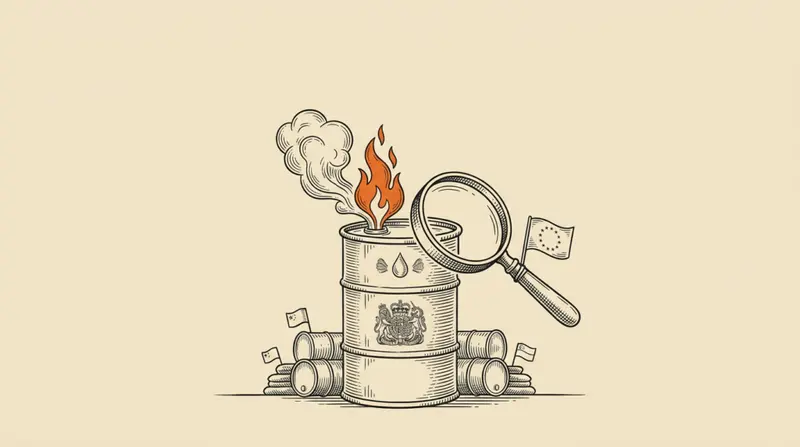
The European Commission is intervening to shield domestic bio-jet fuel refiners from a surge of cheap imports from Asia. European producers raised the alarm after Asian suppliers began delivering fuel at prices that are difficult to justify on the open market. According to industry association the European Biodiesel Board, as much as 95 percent of total Chinese exports of sustainable aviation fuel found its way to the European Union this year. That figure underlines how Europe has become the primary destination for Asian producers looking to offload their surpluses. The Brussels authority is therefore launching an in-depth anti-dumping probe into shipments from China and Singapore.
The investigation has not come out of the blue. The European Biodiesel Board, which represents European renewable fuel producers, lodged a formal complaint with the EU executive in October. In it, producers outline how their sales markets are being squeezed because Asian competitors are pricing biofuels well below standard production costs. European plants are seeing their sales volumes stagnate while imports from Chinese and Singaporean ports rise rapidly. The European Commission will now investigate until January 2028 whether unfair trading practices exist in legal terms and what material injury the European sector is suffering.
A Loophole in European Trade Policy
To understand why this trade spat has erupted now, one must look back at earlier European measures. The European Commission had already imposed hefty tariffs on imports of conventional biodiesel from China. That intervention was designed to shield European biofuel manufacturers from artificially subsidised products. However, European policymakers deliberately left a loophole. Sustainable aviation fuel, widely known in the industry as SAF, was explicitly excluded from the scope of those tariffs. The European Union wanted to avoid stalling the nascent market for greener jet fuel with early trade barriers.
That exemption backfired. Chinese exporters seized the opportunity, swiftly pivoting their refining capacity toward aviation fuels. Refineries in the Far East processed vast quantities of waste fats and used cooking oil into jet fuel that entered the European Union tariff-free. The European Biodiesel Board had been warning for months about this vulnerability in Europe's trade defences. In the absence of tariffs on aviation biofuels, the old biodiesel issue was simply shifted into the jet fuel market. What began as a policy to accelerate decarbonisation turned into an open backdoor for cheap foreign volumes.
A similar shift unfolded in Singapore. The city-state serves as a colossal logistics hub for raw materials and refined products across Southeast Asia. As soon as trade flows to Europe became financially attractive, local facilities processed feedstocks from across the region before shipping them as finished goods to Western ports. European producers noted that supply from Singapore expanded remarkably quickly in tandem with European demand. The European Commission has now included the island nation in the proceedings to determine whether it involves genuine local production or the transhipment of cheap Chinese cargoes designed to circumvent import rules.
Chinese exporters seized the opportunity, swiftly pivoting their refining capacity toward aviation fuels.
Margins Under Pressure at European Refineries
For plants in Belgium, the Netherlands, and the rest of the European Union, the stakes are high. Over recent years, companies have invested hundreds of millions of euros in complex refining facilities that convert animal fats, agricultural residues, and used cooking oil into jet fuel. These investments require stable market prices to cover depreciation and high feedstock costs. Once imported fuel arrives at dumped prices in Rotterdam or Antwerp, the commercial viability of local facilities rapidly erodes.
Crucially, this aggressive price pressure directly erodes the cash balances and margins of European biofuel companies, putting planned expansions and maintenance projects in jeopardy. When European refineries can no longer pass operational costs on to airlines, operating cash flow dries up fast. This not only dampens the appetite for private investment, but also threatens existing bank credit facilities backing green facilities. While manufacturers may boast advanced technology on paper, no European processing plant can endure foreign state subsidies for years without healthy profit margins.
Sustainable aviation fuel differs fundamentally from conventional fossil jet fuel on a technical level. While standard aviation fuel is derived directly from petroleum distillation, SAF is produced from biomass and recycled carbon sources. The fuel can be dropped directly into existing aircraft engines and fuelling infrastructure, typically as a blend with regular fossil kerosene. Its primary advantage lies in full lifecycle emissions: greenhouse gas reductions can reach up to 80 percent compared with pure fossil jet fuel. That environmental benefit makes the fuel a cornerstone of Europe's climate targets for the transport sector.
Tension Between Climate Targets and Trade Defence
The case exposes a sharp paradox in European policy. On the one hand, Brussels is obliging airlines to blend in progressively higher shares of sustainable fuel via the ReFuelEU Aviation initiative. These blending mandates are aimed at cutting flight emissions, but they impose substantial costs on carriers. Green kerosene remains significantly more expensive than standard fossil fuel. For airlines such as KLM, Brussels Airlines, and Lufthansa, every tonne of cheap SAF from Asia offers a welcome way to comply with EU rules without hiking ticket prices exorbitantly.
On the other hand, the European Commission is seeking to build strategic autonomy and prevent the bloc from becoming entirely dependent on China for its energy transition. European leaders are now opting to protect the domestic industrial fabric, even if that means fuel for airlines remains more expensive in the short term. If Europe permits its own refiners to collapse under the pressure of Chinese state subsidies, no European production capacity will survive in the long run. The industry body EBB therefore insists that a level playing field is essential to keep the European bioeconomy afloat.
The European Commission's investigation follows strict World Trade Organization legal procedures. Officials in Brussels must demonstrate that three conditions are met:
- Price difference: showing that Asian producers' export prices are lower than their domestic market prices or true production costs.
- Material injury: proving that European manufacturers are genuinely losing market share, being forced into plant closures, or suffering structural losses.
- Causal link: establishing that the injury is directly caused by the dumped imports rather than other economic headwinds.
Implications for Travellers and the Refining Sector
For Belgian and Dutch citizens and businesses, the developments in Brussels are far from irrelevant. The ports of Antwerp, Ghent, and Rotterdam form the beating heart of European fuel logistics. Numerous refineries and storage providers across these ports have invested heavily in receiving and producing bio-jet fuel. If the European investigation leads to import tariffs by 2028, it would restore the competitive standing of these local operators. That could safeguard local jobs and unlock further investment across Benelux ports.
At the same time, air passengers must brace for the economic fallout. If the influx of rock-bottom Chinese SAF is curtailed with customs duties, average fuel costs for European airlines will rise. Carriers have virtually no margin to absorb these extra expenses themselves. They will pass the higher cost of pricier European bio-kerosene straight through to ticket prices via increased sustainability surcharges. A weekend city break within Europe or a long-haul holiday departing from Brussels Airport or Schiphol will therefore become structurally more expensive as blending mandates ramp up.
The investigation's timetable brings lingering uncertainty for now. The European Commission has announced that the probe will run until January 2028. That means definitive duties will not be in force for well over a year, although Brussels could decide to impose provisional duties midway through the procedure. In the meantime, Chinese producers may attempt to lock in additional market share via long-term contracts. The European Commission is unlikely to hesitate in rolling out interim measures if import volumes from China surge even further over the course of 2027. The question remains whether European producers can weather this interim period financially without further plant shutdowns.
- Antidumping
- Biobrandstof
- China
- EBB
- energy
- European Commission
- Handelsbeleid
- Luchtvaart
- SAF
- singapore

Written by
Bram Hoekstra
Security Editor · Eindhoven (NL)
Expertise
Bram tests wallets, hardware devices, and self-custody setups. He writes about phishing, scams, and how to securely manage your keys.
Related articles
- US Department of Commerce Imposes Licences for AI Chips Shipped to Five Additional Countries
- Brussels Promised a Level Playing Field but Leaves Importers with a €121 Million Bill
- European Commission Approves €2 Billion For Belgian Offshore Wind
- Europe Gains Tool to Close Internal Market Amid Trade War
- Banking Giant DBS Finds Nine in Ten Multinationals Turning to Tokenised Money
- Jardine Cycle & Carriage Loses Analyst Backing, Price Target Cut to €37
Stay in the loop
Follow Block #9.
Daily market and equity news in your feed. Follow us on Facebook and Instagram so you never miss an analysis.
By 7 a.m. you already know
Every Monday, Wednesday, Friday and Sunday morning at 07:00, the overview in your inbox.
Practice without real money or test your knowledge?
Read more
Other interesting articles
EnCore Energy Granted Six-Month Grace Period to Avert US Delisting
- 02Lean Hog Futures Rebound on Friday but End Week Sharply Lower
- 03HeartSciences Converts €3.1 Million Debt Into Equity Ahead of Mining Merger

- 04Large Bitcoin Holders Accumulate Aggressively During Autumn Market Slump
- 05Four Weeks After Multi-Billion Hack, Binance Customers Resume Unrestricted Withdrawals