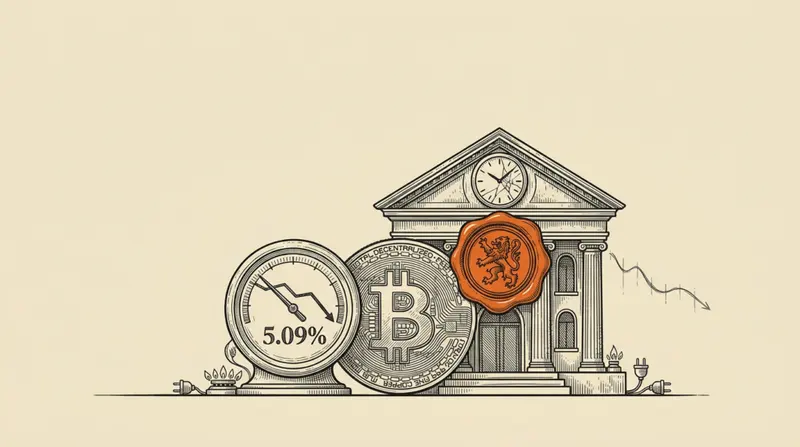
5.09 Percent Inflation Offers Belgian Consumers Merely Temporary Relief
Block #9
5.09 Percent Inflation Offers Belgian Consumers Merely Temporary Relief
In 4 slidesThe gist of this article, fast
- 01
5.09 percent inflation offers Belgian consumers merely temporary relief
Belgian inflation eased slightly to 5.09 percent in November, but persistent price increases for gas and electricity continue to erode real returns…
BLOCK #9 · block9.net - 02
Belgium's inflation slowed to 5.09 percent
Statbel reported that annual inflation edged down to 5.09 percent in November from 5.26 percent in October. Consumer prices still rose by 0.4 percent on a monthly basis.
BLOCK #9 · block9.net - 03
Core inflation eased to 2.47 percent
Stripping out volatile energy and unprocessed food, core inflation dropped to 2.47 percent in November from 2.80 percent in October.
BLOCK #9 · block9.net - 04
Cash savings lose over 300 euros a year
Every 10,000 euros held in savings loses more than 300 euros in net real value annually. Top accounts paying 3.30 percent cannot stop this loss.
BLOCK #9 · block9.net
Belgian inflation eased slightly to 5.09 percent in November, but persistent price increases for gas and electricity continue to erode real returns for savers.
For months, Belgium's cost of living appeared to advance unchecked toward record highs within the eurozone. Today, statistical agency Statbel reported that this upward spiral has slowed marginally for the first time since late summer: headline annual inflation came in at 5.09 percent in November, down from 5.26 percent in October. On a monthly basis, consumer prices nevertheless rose by 0.4 percent. While the decline in the headline annual rate brings a degree of paper calm, dissecting the underlying components reveals immediately that economic overheating remains far from resolved.
The moderation in the headline figure masks a stubborn divide between day-to-day necessities and discretionary spending. While package holidays and motor fuels became cheaper, essential utility bills continue to push household expenditure higher. Customers on natural gas or electricity tariffs saw their rates climb steeply once again last month. That makes this inflationary dip atypical. The index is cooling fractionally, but the reality at supermarket checkouts and upon opening energy bills remains grim.
Price Pressure Shifts Within the Belgian Consumer Basket
According to official measurements by Statbel and the Federal Public Service Economy, the steepest price increases in November occurred in natural gas, electricity and heating oil. Analysts also recorded noticeable price increases for household appliances, clothing and data processing equipment such as laptops and tablets. Households forced to replenish their winter heating oil supplies or replace a broken washing machine felt the impact immediately.
Offsetting those increases was a dampening effect from motor fuels, which were cheaper at the pump than during the same period last year. Stays in holiday parks and campsites also registered a drop in prices—a seasonal correction following the busy autumn school break. Notably, the Federal Public Service Economy reported that food prices in November weighed fractionally less on household budgets than exactly one year prior. That provided some relief at the supermarket, though it hardly compensates for costlier heating bills.
The most telling figure in Statbel's release is core inflation, which strips out volatile energy products and unprocessed food to reveal the underlying trend. Core inflation slipped to 2.47 percent in November, compared with 2.80 percent in October. This suggests that broad price pressures across services and industrial goods are steadily normalising, effectively reducing the remainder of Belgium's inflation problem to an energy issue.
How Belgium Became a Macroeconomic Outlier
To understand why an inflation rate of 5.09 percent remains problematic, one only needs to examine the recent run-up. In September, annual inflation in Belgium stood at 4.69 percent before taking a sharp leap to 5.26 percent in October. The slight pullback to 5.09 percent in November means the country still contends with one of the highest inflation rates across Western Europe. By comparison, French inflation recently fell to 2.9 percent, while Spain posted a reading of 4.1 percent. Belgium consequently lags behind its peers in reining in living costs.
The most telling figure in Statbel's release is core inflation, which strips out volatile energy products and unprocessed food to reveal the underlying trend.
The root of this persistence lies largely within the Belgian energy market and the specific methodology of its consumer price index. Variable-rate energy contracts feed through to Statbel's statistics remarkably quickly. Whereas other member states rely on energy price caps or multi-year fixed contracts that cushion statistical shocks, the Belgian index captures almost every swing in wholesale gas markets in near real-time. When gas and power surge, the impact carves an immediate spike into the Belgian inflation curve.
Belgium's unique system of automatic wage indexation further compounds the effect. Once the so-called pivot index is breached, civil service salaries and social security benefits rise by 2 percent, followed shortly after by private-sector wages. While this safeguards employee purchasing power over the short term, it saddles employers with higher payroll costs that are subsequently passed on through the final prices of goods and services. This linkage structurally delays the decline of Belgian inflation compared to neighbouring countries, ensuring that a transient energy shock reverberates far longer throughout the domestic economy.
Savers and Businesses Watch Real Returns Evaporate
For Belgian and Dutch savers alike, the 5.09 percent headline print delivers a sobering message. Anyone leaving cash in a conventional savings account offering a base rate of roughly 1.5 to 2 percent suffers an ongoing monthly loss in purchasing power. With inflation exceeding 5 percent, every 10,000 euros held in savings loses more than 300 euros in net real value each year. Even the most competitive savings accounts on the market, offering yields of up to 3.30 percent, currently fall short of shielding consumers from real depreciation.
In financial markets, this relentless erosion of cash value creates a tough dilemma, as risk assets have failed to serve as an obvious safe haven in recent months. Market anxiety remains pronounced: the broader cryptocurrency sector stood at a total market capitalisation of 1.89 trillion euros on 24 November at 17:29, following a 24-hour decline of 7.1 percent, with the benchmark Fear and Greed Index indicating extreme fear at 12 out of 100. Bitcoin traded at 54,415 euros at the time, down 25.8 percent over thirty days and nearly half below its all-time high. Savers seeking protection from inflation are left facing an environment where both cash holdings and volatile investments carry considerable risk.
For businesses, the pressures cut both ways. Belgian companies are not only dealing with inflated energy bills and raw material expenses, but are also forced to brace for fresh rounds of statutory wage indexation. For small and medium-sized enterprises operating on narrow margins, passing these dual cost increases entirely on to end-customers is becoming virtually impossible. Dutch businesses operating across the border in Belgium, meanwhile, are noticing softer demand for non-essential goods as Belgian consumers allocate a growing share of disposable income to fixed utility bills.
Winners and Losers in the Current Price Environment
The shifting composition of the inflation basket is carving out distinct winners and losers across the economy:
- Energy utilities and the public purse: Gas and electricity suppliers are capitalising on elevated wholesale tariffs, while the state collects additional revenue through value-added tax on energy alongside higher nominal income tax receipts generated by indexed wages.
- Domestic energy-intensive enterprises: Manufacturers, bakeries and industrial suppliers consuming high volumes of gas and electricity are witnessing rapid margin compression, unable to lift output prices at an equivalent pace.
- Low-income households: Families spending a substantial portion of their monthly earnings on indispensable utilities and appliances are disproportionately affected by this specific profile of price increases.
- Travel and hospitality operators: Holiday parks and campsite operators have had to trim rates to maintain occupancy levels, pointing to a consumer base that is growing far more discerning regarding discretionary leisure outlays.
Two Realistic Scenarios for Winter Price Trajectories
Looking ahead to the winter months, two distinct paths emerge for Belgian consumer price developments. The first scenario assumes that geopolitical frictions and seasonal cold snaps keep wholesale prices for natural gas and heating oil elevated or push them higher still. Under these conditions, headline inflation would bounce back above 5.5 percent. Automatic indexation thresholds would trigger earlier than expected, unleashing another cost push for employers and sustaining high inflation well into spring.
The second scenario builds upon the underlying trajectory of core inflation. If the decline from 2.80 to 2.47 percent persists and energy futures stabilise, a strong base effect will take hold as prices are measured against elevated year-earlier levels. In this outcome, headline inflation could drift down toward 3.5 percent by the close of the first quarter. The retreat in core inflation suggests that weakening consumer demand is already curbing retailers' pricing power, creating stiff resistance to further price rises beyond the energy complex.
The Counterargument and Indicators That Could Shift the Outlook
The thesis that Belgian inflation will remain structurally elevated due to energy and wage dynamics is not without counterarguments. Observers highlight that the month-on-month drop in core inflation of over 0.3 percentage points was unusually sharp. If consumers curtail discretionary outlays on clothing, electronics and recreation en masse, the resulting disinflationary drag could comfortably outweigh rising energy bills. Furthermore, annual food price inflation has already begun to ease fractionally, which historically acts as a powerful brake on broader public inflation expectations.
What data point would genuinely upend this cautious assessment? Should core inflation take another pronounced tumble in December—dropping below 2.0 percent, for example—it would confirm that domestic demand is decelerating much faster than anticipated. Such an outcome would show that economic activity is sputtering to the point where companies no longer dare pass through higher operating costs. Until those prints arrive, November's slip to 5.09 percent represents little more than a statistical pause, while living costs for households remain acutely elevated.
- Belgium
- bitcoin
- europe
- Inflation

Written by
Bram Hoekstra
Security Editor · Eindhoven (NL)
Expertise
Bram tests wallets, hardware devices, and self-custody setups. He writes about phishing, scams, and how to securely manage your keys.
Related articles
- Thales Acquires Control of Laser Specialist Lumibird for €30.10 Per Share
- Russian Ransomware Group The Gentlemen Claims 1,000 Victims in Single Year
- Belgium to Reach 1.1% Growth in 2027, Forecasts BNP Paribas Fortis
- €26 Million in Crypto Transactions Exposed in European Piracy Services
- Why CleanSpark Now Plans to Sell More Bitcoin Than It Actually Mines
- Borrowing Costs to Stay High as US Inflation Rises to 3.8 Percent
Stay in the loop
Follow Block #9.
Daily market and equity news in your feed. Follow us on Facebook and Instagram so you never miss an analysis.
Practice without real money or test your knowledge?
Read more