Malaysia Welcomes First Sharia-Compliant Bitcoin ETF via Halogen
ETFs
Malaysia Welcomes First Sharia-Compliant Bitcoin ETF via Halogen
In 4 slidesThe gist of this article, fast
- 01
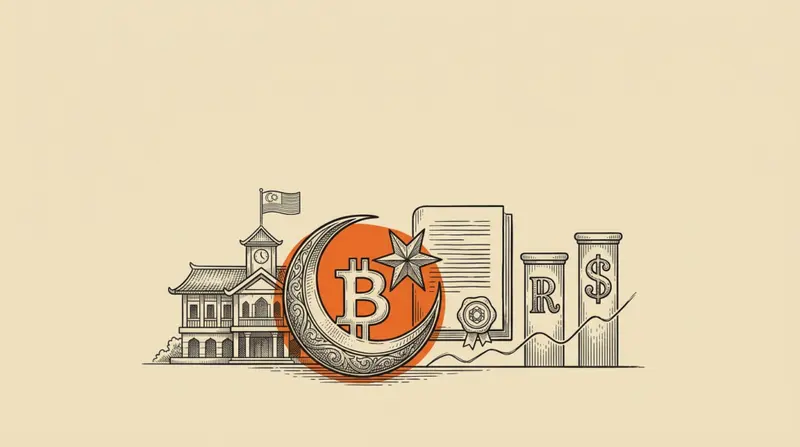
Malaysia welcomes first sharia-compliant Bitcoin ETF via Halogen
From 2 December, Bursa Malaysia will list an exchange-traded fund holding physical bitcoin in accordance with Islamic financial principles.
BLOCK #9 · block9.net - 02
Malaysia lists the first Sharia bitcoin ETF
Bursa Malaysia will list the Halogen Shariah Bitcoin ETF on 2 December, holding physical coins rather than derivatives.
BLOCK #9 · block9.net - 03
Supervision sets a benchmark for Islamic capital
Registered adviser Amanie Advisors certified the structure, confirming bitcoin qualifies as legitimate property under Malaysian asset law.
BLOCK #9 · block9.net - 04
Total annual structural expenses reach 0.65%
Halogen Capital sets a management fee up to 0.60 per cent alongside a 0.05 per cent trustee fee, trading under tickers 0840EA and 0840EB.
BLOCK #9 · block9.net
From 2 December, Bursa Malaysia will list an exchange-traded fund holding physical bitcoin in accordance with Islamic financial guidelines.
Malaysian asset manager Halogen Capital is making a notable move to channel institutional and Islamic capital into digital assets. The fund house aims to appeal to traditional investors who have held back until now due to religious principles or operational hurdles. On 2 December, the exchange-traded fund will debut on the main market of Bursa Malaysia, offering retail and institutional participants access at a maximum annual management fee of 0.60 per cent.
The launch of the Halogen Shariah Bitcoin ETF marks the arrival of the world’s first exchange-traded bitcoin fund formally certified as sharia-compliant. The fund tracks the FTSE Bitcoin Index and purchases actual physical bitcoin rather than relying on synthetic derivatives or futures contracts. For asset safekeeping, the manager has engaged a global custodian to hold the coins in segregated accounts. In addition, the fund pays a trustee fee capped at 0.05 per cent per annum.
How Islamic Finance and Physical Bitcoin Converge
Structuring an investment fund around the principles of Islamic finance demands a specialised oversight framework. In Islamic jurisprudence, interest, excessive uncertainty and gambling are strictly forbidden, which historically made allocations to volatile assets complex. To secure and retain its sharia-compliant status, the fund is supervised by Amanie Advisors, a specialised sharia consultancy formally registered with the Securities Commission Malaysia, the country's securities market regulator.
Sign-off from the regulator and the sharia adviser confirms that holding bitcoin as an underlying asset is recognised as legitimate property under Malaysian asset law. The vehicle mandates that the acquired coins must be held in physical form and cannot be lent out for leveraged trading or interest-bearing lending arrangements. This aligns with a broader global trend where traditional exchanges demand direct physical backing to eliminate counterparty risk.
Trading on Bursa Malaysia will be conducted across two distinct counters with their own exchange tickers. Investors can trade shares in the local currency, the Malaysian ringgit, under ticker 0840EA. For international investors and participants seeking to avoid foreign exchange conversions, a secondary listing denominated in US dollars is offered under ticker 0840EB. Transactions are cleared through licensed stockbrokers, ensuring investors do not need to set up personal crypto wallets or interact with unregulated digital asset exchanges.
Cost Structure and Margins for the Malaysian Fund House
For manager Halogen Capital, this rollout establishes a clear business model alongside rigorous operational commitments. The annual management fee of up to 0.60 per cent sits noticeably above the rock-bottom rates seen in the United States, where issuers such as BlackRock and Fidelity typically set fees between 0.12 and 0.25 per cent. Halogen Capital’s higher margin per euro under management will comfortably absorb the operational overheads of specialised sharia audits and segregated custody, while cementing a near-monopoly across its domestic market.
Trading on Bursa Malaysia will be conducted across two distinct counters with their own exchange tickers.
The additional trustee fee, capped at 0.05 per cent annually, has a negligible effect on fund cash flow. Combined with the management fee, the total structural expense ratio for investors stands at approximately 0.65 per cent per year. This margin affords the fund house sufficient financial leeway to guarantee market liquidity and remunerate the custodian for the physical segregation of the crypto assets. For large Southeast Asian Islamic pension funds and family offices, this premium is generally acceptable, as they are legally barred from investing without formal certification from a body such as Amanie Advisors.
The broader market backdrop to this market debut remains decidedly defensive. According to Block #9 market data recorded on 24 November at 17:29, bitcoin trades at 54,415 euros, marking a 5.4 per cent decline over the previous 24 hours and a 25.8 per cent drawdown over the past 30 days. The Fear & Greed index stands at 12 out of 100, signalling extreme fear among market participants. The fact that Halogen Capital is holding firm to its 2 December launch date underlines that the fund is tailored for long-term allocations by savers and institutions rather than short-term momentum chasing during a bull market.
The Asian Counterpart to Wall Street Fund Flows
Ever since the US Securities and Exchange Commission approved spot bitcoin ETFs in early January, regulated trackers have spread across multiple continents. While the United States and Hong Kong chose generic investment vehicles for the broader market, Malaysia is deliberately capitalising on its standing as an international hub for Islamic finance. Kuala Lumpur has spent decades establishing itself as a pioneer in sukuk (Islamic bonds) and is now extending this structural expertise to digital assets.
In terms of scale, the Malaysian exchange cannot compete with Wall Street, but the symbolic reach of this product extends far beyond domestic borders. Across the global Muslim population of nearly two billion people, a vigorous theological debate has run for years over whether bitcoin qualifies as money (mal) or constitutes impermissible speculation (gharar). Formal approval from the Securities Commission Malaysia and Amanie Advisors sets a legal and religious benchmark that will be scrutinised closely by supervisory authorities across the Middle East.
On the trading floor of Bursa Malaysia, stockbrokers gain access to a new client segment. Malaysian retail savers who previously turned to unregulated offshore platforms can now incorporate the cryptocurrency directly into their existing securities accounts. Settlement across both ringgit and US dollars also lowers the threshold for institutional investors based in neighbouring countries such as Indonesia, home to the world’s largest Muslim population.
Implications for European Investors and Regulators
For investors in Belgium and the Netherlands, the Malaysian listing brings no direct trading consequences, yet it offers valuable insights into global market architecture. European investors cannot readily access the local exchange in Kuala Lumpur without specialised international brokers providing Asian market access. Furthermore, the European Union recently rolled out MiCA, which imposes strict standards on the issuance and trading of crypto-assets, while standard UCITS guidelines continue to rule out physically backed, single-asset bitcoin ETFs within EU boundaries.
For listed crypto exposure, European retail investors must instead turn to exchange-traded products (ETPs) or exchange-traded notes (ETNs) traded on venues like Euronext Amsterdam or Deutsche Börse Frankfurt. These European debt securities employ a different legal structure than US or Malaysian trusts, even if their economic exposure is comparable. Bursa Malaysia’s decision highlights how regulators outside the West are increasingly opting for pragmatic integration rather than administrative hesitation.
At the same time, the Malaysian rollout serves as a reminder to European asset managers that demand for ethical and faith-aligned strategies is building. Across European metropolitan centres, interest in sharia-compliant wealth management is expanding beyond its traditional core of real estate certificates and equity funds that screen out heavily indebted firms. A formal sanctioning of bitcoin within this spectrum may ultimately prompt European managers to explore similar structures under MiCA rules.
Editorial Assessment
We believe the success of the Halogen Shariah Bitcoin ETF will not be defined by opening-day trading volumes, but by net capital inflows sustained over several quarters. The Malaysian market is inherently conservative, and institutional allocations require extensive reviews by internal investment committees. The fund must first demonstrate that its tracking error against the FTSE Bitcoin Index remains tight and that liquidity through local market makers holds up during turbulent market sessions.
Attention will also turn to the reaction of financial centres across the Gulf, including Dubai and Abu Dhabi, which are competing to become the global capital for regulated crypto-assets. If Malaysia demonstrates that a sharia-compliant ETF can operate without friction, equivalent funds in the United Arab Emirates and Saudi Arabia are likely to follow. From 2 December, it will become clear whether traditional Islamic capital is prepared to make the step into the world’s leading digital asset.
- Amanie Advisors
- bitcoin
- Bursa Malaysia
- etf
- ftse
- Halogen Capital
- Institutional
- Maleisië
- regulation
- sharia

Written by
Wouter De Clerck
Economy Editor · Leuven (BE)
Expertise
Wouter follows macroeconomics, interest rate policy, and precious metals. He connects central bank decisions with what happens in the crypto and gold markets.
Stay in the loop
Follow Block #9.
Daily market and equity news in your feed. Follow us on Facebook and Instagram so you never miss an analysis.
By 7 a.m. you already know
Every Monday, Wednesday, Friday and Sunday morning at 07:00, the overview in your inbox.
Practice without real money or test your knowledge?
Read more