Ukrainian Crypto Investors Face Near-25% Tax on Profits from 2027
Taxes
Ukrainian Crypto Investors Face Near-25% Tax on Profits from 2027
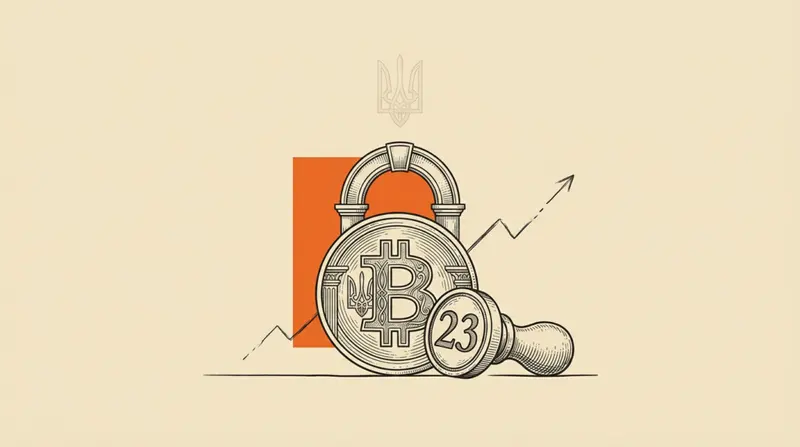
After three years of drafting, parliament in Kyiv has approved a comprehensive regulatory framework, targeting over €300 million in additional tax revenues.
For years, Ukrainian cryptocurrency holders operated in a grey area where digital assets enjoyed widespread popularity, yet formal tax rules and robust regulatory oversight were absent. That is now set to change following the passage of a landmark bill in Ukraine's parliament, which aims to fully regulate and tax the market from 1 July 2027. Lawmakers approved the text on its final reading with 271 votes. Before the legislation formally takes effect, President Volodymyr Zelensky must still sign the bill into law, but the framework for both individuals and crypto platforms is now clearly drawn.
Key Details of the New Tax Regime
At the heart of the new legislation lies a clear levy on net capital gains realised by retail investors on the sale of crypto assets. Anyone converting crypto into fiat currency under the standard regime will pay a combined rate of 23 per cent. This charge comprises an 18 per cent standard personal income tax alongside a 5 per cent military levy to support the war effort. The tax is calculated on annual net returns: investors may offset realised losses against capital gains and carry forward any remaining losses into subsequent tax years.
Crucially, not every transaction triggers an immediate tax assessment. Direct exchanges between different cryptocurrencies—so-called crypto-to-crypto swaps—are explicitly tax-exempt. A taxable event arises only once an investor converts holdings into traditional fiat currency. For early market entrants who acquired their tokens prior to the July 2027 rollout, lawmakers have introduced a transitional arrangement. Anyone liquidating such early holdings into fiat before the end of 2028 can opt for a flat 10 per cent tax on total gross sales proceeds, likewise split into a 5 per cent income tax and a 5 per cent military levy.
Supervision of the sector will be divided between two established authorities. The National Bank of Ukraine will oversee issuers of stablecoins pegged to a single official currency and set eligibility criteria for foreign tokens functioning as electronic money, as explained by central bank governor Andriy Pyshnyy. The remainder of the market, including crypto exchanges and brokers for other crypto assets, will fall under the remit of the National Securities and Stock Market Commission. Kyiv has thus adopted a model closely aligned with the regulatory division seen across the European Union.
Three Years of Negotiations Under Severe Fiscal Pressure
The 271-vote majority followed more than three years of legislative wrangling. Ukraine historically ranks among the countries with the highest crypto adoption globally, driven partly by the need for swift cross-border payments and capital preservation during wartime. Yet throughout this period, the state treasury saw virtually no substantive revenues from these digital capital flows. With this legislation, the government is targeting annual tax receipts of roughly $332 million, or approximately €315 million in direct revenue.
The remainder of the market, including crypto exchanges and brokers for other crypto assets, will fall under the remit of the National Securities and Stock Market Commission.
For Ukraine’s public finances, this projected €315 million per year provides a welcome boost to state coffers that have been strained for years by soaring defence and reconstruction expenditure. At the same time, the 23 per cent rate significantly erodes margins for active traders, who had previously operated virtually unburdened by tax. The war economy has forced lawmakers to systematically tap every viable domestic revenue stream, with the 5 per cent military surcharge making that harsh reality unmistakably clear.
The timing of the legislation coincides with a broader cooldown across international crypto markets. While investors enjoyed record gains a few years ago, current market conditions paint a far tougher picture. According to Block #9 market data recorded on 24 November at 17:29 Brussels time, bitcoin was trading at €54,415, down 25.8 per cent over the past thirty days and nearly half below its all-time high. With the Fear & Greed Index sitting at a frigid 13 out of 100 at that time, retail profits remain scarce, suggesting that state coffers may only see the expected hundreds of millions flow in once market sentiment rebounds.
What the Legislation Means for Belgian and Dutch Readers
Although the Ukrainian tax law primarily affects domestic residents and companies, it carries clear implications for European market participants. Ukraine is an EU candidate country and is swiftly harmonising its economic legislation with European standards. The definitions chosen and the division between the central bank and the securities regulator closely mirror the MiCA regulation currently being phased in across the European Union. Businesses in Belgium or the Netherlands working with Ukrainian fintech firms or software developers will soon be dealing with counterparts operating under a fully fledged regulatory framework.
On the tax front, Ukraine’s approach highlights stark contrasts with domestic frameworks in the Low Countries:
- Belgium: Private individuals are generally exempt from tax on capital gains under the normal management of private wealth, but face a 33 per cent charge if tax authorities classify transactions as speculative, with loss carry-forwards between tax years largely prohibited.
- The Netherlands: Crypto holdings fall under Box 3 based on a deemed return on other assets, meaning investors pay wealth tax on their asset values as of the 1 January reference date, regardless of whether they have sold tokens or realised actual gains.
- Ukraine: From mid-2027, the country is opting for a pure capital gains tax on net realised proceeds, paired with an indefinite carry-forward of losses into subsequent tax years.
Furthermore, international data-sharing frameworks are steadily eliminating blind spots for tax authorities. Under EU rules such as DAC8, crypto exchanges will be mandated to report transaction data of European citizens to national tax authorities. As Ukraine integrates into international tax treaties governing crypto assets, holding undisclosed wealth through Ukrainian platforms or exchanges will become impossible for investors in the Low Countries.
What to Watch in the Coming Months
While parliamentary approval represents the most significant hurdle, the file is far from settled. The real test will lie in implementing the secondary legislation. The National Bank of Ukraine and the securities supervisor must build out a comprehensive licensing regime for exchanges and custodians over the next two years. Without that operational infrastructure, statutory texts remain little more than paper tigers.
President Zelensky’s final signature also remains a key milestone. In the past, the head of state returned earlier crypto bills to parliament after jurisdictional splits between regulators conflicted with constitutional guidelines. Analysts expect this text to pass muster, but until the bill is formally signed, theoretical risks persist.
Finally, the reaction of Ukraine’s domestic crypto sector will be closely watched. With an implementation date set for 1 July 2027, market participants and investors have ample runway to adapt. The critical question is whether a 23 per cent rate will trigger capital flight, or whether legal clarity and enhanced banking access will prove more valuable to major players. In the months ahead, the willingness of domestic banks to open their doors to regulated crypto companies will serve as the true litmus test for this landmark reform.
- Andriy Pyshnyy
- belastingen
- bitcoin
- Crypto Exchanges
- European Union
- mica
- Oekraïne
- regulation
- Stablecoins
- Wetsvoorstel

Written by
Amina El Yazidi
Tax Editor · Brussels (BE)
Expertise
Amina follows tax rules around crypto in the Netherlands and Belgium. She translates fiscal legal texts into practical steps for retail investors.
Related articles
- European Banking Authority Demands Stricter Rules for Crypto Firms Guiding Clients to DeFi
- Seoul Unveils New Crypto Framework, Granting Banks Control Over Stablecoins
- MoonPay Applies for US Trust Bank Charter to Issue Stablecoins and Offer Custody Services
- US Congress to Vote on New Crypto Tax Rules on Wednesday
- House of Representatives Simplifies Crypto Taxes Amidst Political Resistance
- Germany Aims to Tax Bitcoin Gains Like Equities, Expects €350 Million in Additional Revenue
Stay in the loop
Follow Block #9.
Daily market and equity news in your feed. Follow us on Facebook and Instagram so you never miss an analysis.
By 7 a.m. you already know
Every Monday, Wednesday, Friday and Sunday morning at 07:00, the overview in your inbox.
Practice without real money or test your knowledge?
Read more