Monero Spot Trading to End on 30 November, KuCoin Confirms
Crypto Exchanges
Monero Spot Trading to End on 30 November, KuCoin Confirms
In 4 slidesThe gist of this article, fast
- 01
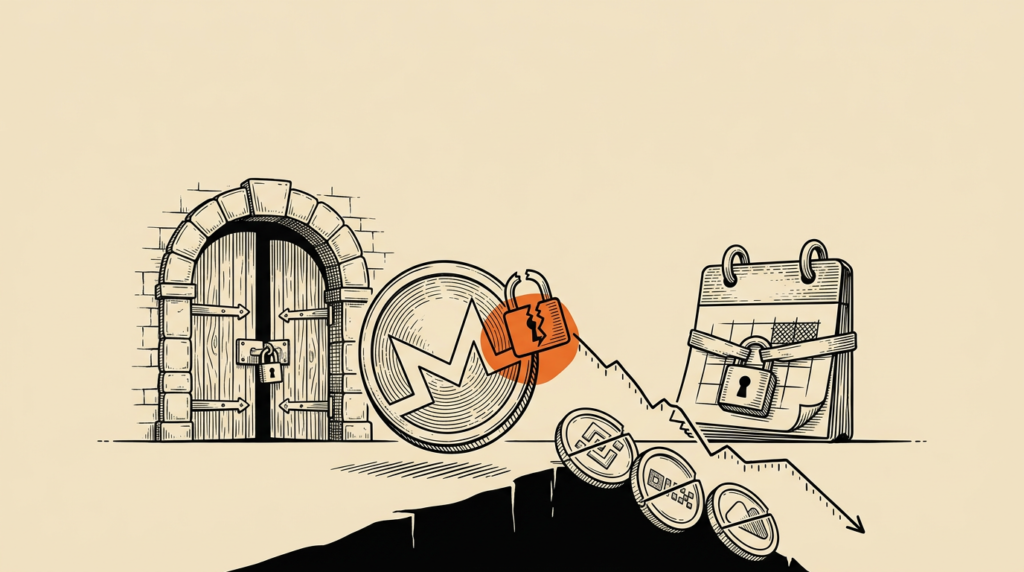
Monero spot trading to end on 30 November, KuCoin confirms
Following exits by Binance, OKX, and MEXC, KuCoin is now closing its doors to Monero, wiping out nearly half of global spot volume in one blow.
BLOCK #9 · block9.net - 02
KuCoin drops Monero spot trading
The platform halts trading on 30 November. KuCoin previously handled 47% of global spot volume for Monero, recording $73.8 million in 24-hour turnover.
BLOCK #9 · block9.net - 03
Monero drops 15% following the news
XMR tumbled to $436 shortly after the announcement. KuCoin closed deposits right away and told customers to withdraw their tokens before 31 December.
BLOCK #9 · block9.net - 04
Exchanges pull the plug on privacy coins
MEXC dropped XMR on 13 November, following earlier bans by Binance and OKX. HTX is now the largest centralised spot venue, holding $29.5 million in daily volume.
BLOCK #9 · block9.net
Following exits by Binance, OKX, and MEXC, KuCoin is now closing its doors to Monero, wiping out nearly half of global spot volume in one blow.
Monero’s price took a heavy hit on Thursday, tumbling nearly 15% within four hours to a low of $436 (around €402). The sudden wave of selling came directly on the heels of an announcement from crypto exchange KuCoin, confirming it will permanently halt spot trading in the privacy-focused cryptocurrency on 30 November at 09:00 (Belgian time). For traders and users, this removes the most critical centralised marketplace for Monero at a time when market sentiment was already under severe pressure.
The timing of the decision carries extra weight. On 24 November at 17:29, Block #9's fear and greed index registered a reading of just 11 out of 100, indicating extreme fear among crypto investors. The total crypto market stood at €1.89 trillion at that point, following a 7.1% drop over 24 hours, while bitcoin had already recorded a 25.8% decline over a 30-day period. In such a fragile market climate, removing a central pillar of liquidity almost immediately triggers sharp price fluctuations.
Half of global spot trading wiped out in one stroke
The impact of KuCoin's move is best understood through its market share. The XMR/USDT trading pair on KuCoin accounted for $73.8 million (around €68.1 million) in 24-hour trading volume on the day of the announcement, according to CoinMarketCap data. That gave the exchange a staggering 47% share of total global spot trading in Monero. By comparison, second-placed HTX trailed far behind with a 24-hour volume of $29.5 million (around €27.2 million).
KuCoin stated that the delisting stems from its Special Treatment rules for assets. The platform closed XMR deposits immediately on Thursday. On 30 November, the exchange will remove four trading pairs: XMR against USDT, USDC, ether, and bitcoin. In addition, trading bots, Convert swaps, and Earn savings products linked to the token will be discontinued. Customers have until 31 December to withdraw their remaining Monero, though the exchange warned that withdrawals may close earlier if the Monero network experiences delays or halts transaction processing. Furthermore, borrowers using XMR as collateral were urgently advised to supply alternative collateral in time to avoid liquidations.
Notably, KuCoin's official statement made no mention of the perpetual derivatives contract XMRUSDT. That contract accounted for a 24-hour volume of $33 million (around €30.4 million) on Thursday. That left KuCoin smaller than Binance, which, despite having previously delisted spot trading, still hosts the largest derivatives market for Monero with a volume of $89.3 million (around €82.4 million).
KuCoin stated that the delisting stems from its Special Treatment rules for assets.
A string of delistings corners privacy coins
KuCoin’s decision is not an isolated event, but rather the latest chapter in an ongoing exodus of centralised trading platforms from privacy coins. Earlier this month, on 13 November, exchange MEXC ceased both spot and derivatives trading in Monero. In doing so, MEXC extended a trend that gathered pace in early 2024 when OKX pulled the plug on XMR in January.
In February 2024, market leader Binance followed suit with a full delisting of Monero, arguing that the token no longer met industry standards in an evolving sector. At that time as well, the news sparked a price drop of more than 15%. Kraken has also steadily restricted trading: in late October 2024, the platform shut down trading for clients in the European Economic Area, followed by an announcement in August 2025 of similar measures for Canadian users, who lost access permanently on 2 September 2025.
In a broader industry context, KuCoin had until now been the major outlier among large global exchanges, keeping Monero open to a broad audience despite intense regulatory pressure. While HTX now suddenly becomes the largest remaining centralised spot exchange for XMR, history with Binance and OKX shows that losing such a market leader creates structural liquidity issues that smaller platforms rarely absorb in full.
European rules and custody obligations hit the Benelux
For Belgian and Dutch crypto investors, KuCoin's move highlights how tightly the net is closing around anonymity. Since the introduction of the European MiCA regulation and stricter anti-money laundering directives, regulated crypto firms in the European Union are prohibited from offering tokens whose transaction history is entirely obfuscated. Exchanges seeking to obtain or maintain a licence in Europe must be able to prove who is sending what to whom—a requirement that Monero’s cryptographic ring signatures fundamentally cannot satisfy.
Although KuCoin formally operates outside the European Union, global pressure from regulators is forcing overseas platforms to adjust their risk profiles as well. For users in Belgium and the Netherlands, this means Monero is becoming virtually inaccessible via established payment rails such as iDEAL or Bancontact. Anyone still holding the coin on KuCoin must take action before year-end by transferring funds to a personal wallet or converting the balance into a transparent cryptocurrency such as bitcoin or a stablecoin.
Liquidity inevitably shifts to decentralised swap services
KuCoin’s departure as a source of liquidity carries consequences that reach far beyond its own order book. In practice, the exchange served as the engine behind dozens of instant swap exchanges—services allowing users to trade tokens without an account. Following the announcement, market commentator PerpetualCow pointed out that more than half of Monero users acquired their tokens indirectly via KuCoin, as such swap services hold minimal proprietary liquidity and route their orders straight into KuCoin’s order book.
With that underlying liquidity gone, transaction fees and slippage on these swap services threaten to increase considerably. As an alternative, advocates of the token are increasingly looking toward decentralised protocols and peer-to-peer networks. Platform Wagyu, a marketplace facilitating XMR trade flows among others, reported a 24-hour volume on Thursday of $63.5 million (around €58.6 million) in the XMR/USDC pair, and total volume exceeding $1.5 billion (around €1.38 billion) in less than a year.
What to watch next: remaining derivatives and network halts
Following this announcement, several uncertainties remain that could dictate Monero’s price trajectory in the coming weeks. Going forward, attention will centre primarily on the resolution of open leveraged positions and loans on KuCoin, and whether other platforms follow KuCoin’s lead regarding their remaining futures contracts.
- Collateral risk: borrowers who deposited XMR as collateral must supply alternative assets before 30 November, potentially triggering forced liquidations if positions are not settled in time.
- Derivatives exchanges: because KuCoin is leaving futures contracts untouched for now, an imbalance is emerging between a shrinking spot market and leveraged trading that continues elsewhere, such as on Binance.
- Withdrawal deadline: the exchange has explicitly reserved the right to halt withdrawals before 31 December if the network faces disruption, prompting users not to wait until the final week.
Liquidity in Monero appears to be decoupling permanently from the regulated financial system. The question is no longer which major exchange will follow next, but whether decentralised exchanges and peer-to-peer trading can provide sufficient depth to absorb substantial capital flows.
- Binance
- kraken
- kucoin
- MEXC
- mica
- monero
- OKX
- privacy
- regulation
- xmr

Written by
Thijs Molenaar
Investment Editor · The Hague (NL)
Expertise
Thijs writes about stocks, index funds, and the cross-pollination between stock markets and crypto. He dissects quarterly figures from AI and chip companies and what they mean for investors.
Related articles
- Dormant Zcash Worth €10.8 Million Moves to Kraken After Nine Years
- North Korea Struck Binance, Washington Demands $1.1 Billion Back
- Ahead of Trump Dinner, Half of Qualifying Wallets Appear Foreign
- Kraken Drops Questionnaire for Monero Withdrawals and Retains Listing
- Bitcoin Surges Over 24 Percent in August, Ignores Iran Tensions
- Zcash Surges 45 Percent In One Week As Bitcoin Holds Steady Around €73,500
Stay in the loop
Follow Block #9.
Daily market and equity news in your feed. Follow us on Facebook and Instagram so you never miss an analysis.
By 7 a.m. you already know
Every Monday, Wednesday, Friday and Sunday morning at 07:00, the overview in your inbox.
Practice without real money or test your knowledge?
Read more