After Strong Quarter, Software Giant SAP Considers Cutting at Least 10,000 Jobs
Stocks
After Strong Quarter, Software Giant SAP Considers Cutting at Least 10,000 Jobs
In 4 slidesThe gist of this article, fast
- 01
After strong quarter, software giant SAP considers cutting at least 10,000 jobs
The German technology group plans to shed up to 10% of its workforce to fund its transition to artificial intelligence, despite surging cloud profits.
BLOCK #9 · block9.net - 02
SAP considers cutting at least 10,000 jobs
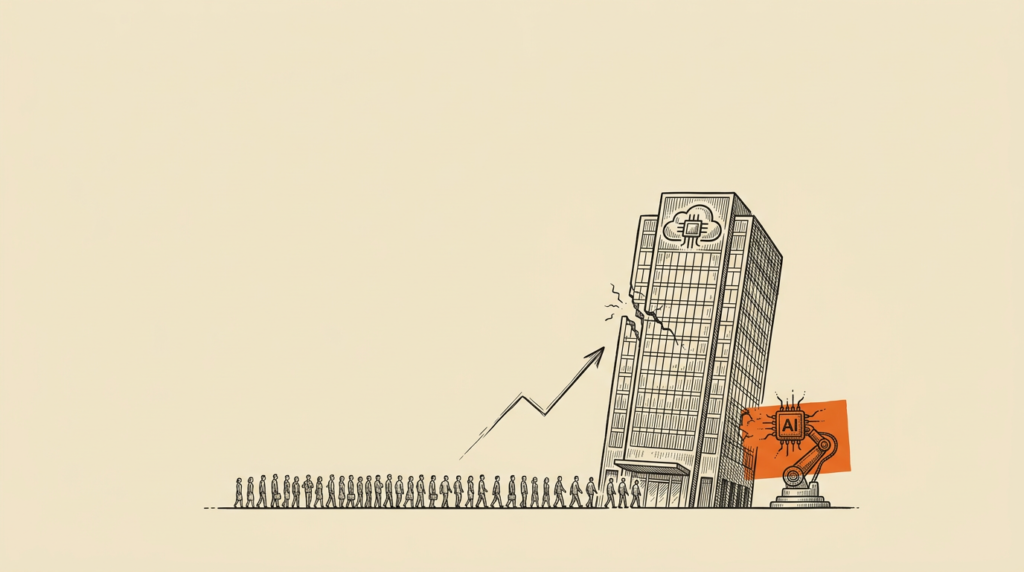
Chief executive Christian Klein is preparing to eliminate up to 10% of the global workforce to fund a transition to artificial intelligence.
BLOCK #9 · block9.net - 03
Engineering and sales face the heaviest cuts
Product development teams will bear the brunt of the reduction as automated coding tools allow fewer developers to build software.
BLOCK #9 · block9.net - 04
Cloud revenue surged 26% to €6.67 billion
The planned cuts come despite strong quarterly health, with net profit rising 11% to €2.27 billion in the third quarter of 2026.
BLOCK #9 · block9.net
The German technology group plans to shed up to 10% of its workforce to fund its transition to artificial intelligence, despite surging cloud profits.
Behind the scenes, executive management at German software giant SAP is preparing a wide-ranging restructuring programme to accelerate the alignment of its enterprise software suite with the rise of artificial intelligence. Chief executive Christian Klein aims to overhaul thoroughly the way the company develops and sells its business software, particularly as corporate clients scrutinise ever more closely whether these technological additions justify their hefty investments. According to people familiar with the matter, the software firm is therefore considering eliminating at least 10,000 positions, a measure affecting roughly 9% to 10% of its global workforce.
News agency Bloomberg was first to report the internal plans, citing sources who spoke on condition of anonymity. According to these same insiders, the final headcount reduction has not yet been set in stone. The scope of the cuts could still shift in the coming weeks following negotiations with staff representatives and works councils. In an official response to news broadcaster Euronews, the Walldorf-based listed company declined to comment directly on the figures, though it did confirm that artificial intelligence is rapidly upending the enterprise market and that staffing levels remain under continuous review.
Equity markets responded cautiously to the news on Friday morning. On the Frankfurt Stock Exchange, SAP shares were trading roughly 0.5% lower at €193.18 around midday, following a modest 0.30% gain in earlier US trading. Investors have long kept a close eye on the vast sums legacy tech giants are pouring into new computing models, particularly as first-generation enterprise AI deployments do not automatically generate higher margins for clients.
The shift to artificial intelligence exacts its toll
The core of the planned reorganisation strikes at the heart of SAP's business model. For decades, the multinational has provided the digital backbone for tens of thousands of large corporations worldwide, managing accounting, payroll administration, and complex supply chains. Under Christian Klein's leadership, the company is attempting to transform these sprawling systems into self-learning software capable of autonomously flagging inventory shortages, processing invoices, and adjusting sales forecasts.
That transition has not been without resistance from corporate clients. Over recent quarters, several major customers have openly questioned whether the price premium for the latest AI modules is justified by tangible workplace productivity gains. To protect margins while funding massive capital expenditure on data centres and computing capacity, the executive board has instructed all divisions to identify potential cost savings. Leaked plans suggest the heaviest reductions will fall on product development, engineering departments, and global sales teams.
Cutting developer roles marks a sharp break with the past, when IT giants lured programmers with record compensation packages. Today, the deployment of automated coding assistants allows fewer developers to produce and test the same volume of software code. Where software firms once required linear headcount growth to serve more clients, advanced automation is now rapidly decoupling that relationship.
Acquisitions as building blocks for a new software era
While thousands of regular employees face uncertainty over their jobs, SAP has spent heavily in recent months to bring in external expertise. Rather than building missing capabilities in-house, the group has deliberately opted to acquire ready-made solutions through targeted takeovers of specialist technology firms. Several notable transactions have been completed recently:
Cutting developer roles marks a sharp break with the past, when IT giants lured programmers with record compensation packages.
- TechWolf: a Belgian start-up based in Ghent that uses AI to map employee skills and match them to open roles across large enterprises.
- Prior Labs: a developer of specialised AI models trained specifically to analyse and structure complex corporate data.
- Dremio: a company supplying software that connects data from dozens of disconnected enterprise systems into a unified analytics environment without latency.
- Reltio: a specialist in modern data management acquired by the German group in May to clean up corporate data sources.
The acquisition of Belgian-based TechWolf illustrates the harsh dynamic of today's tech sector. Even as SAP invests in technology designed to measure working patterns and skill gaps within corporations, the group is deploying similar efficiency insights internally to pinpoint roles it considers redundant. Management is reshaping its workforce by replacing conventional administrative and support positions with highly specialised data professionals.
Surging cloud figures mask internal reorientation
The potential reduction of 10,000 jobs comes at a time when the business appears in robust financial health. In the third quarter of 2026, cloud revenue climbed 26% year on year to €6.67 billion. Net profit after tax rose 11% to €2.27 billion over the same period. The company also posted steady expansion across prior financial years: cloud receipts increased by 25% in 2024 and 23% in 2025, which, adjusted for currency movements, represented 26% growth in both years.
Unlike previous restructuring rounds where job cuts were primarily deployed to reverse steep losses, SAP shows no signs of an ailing revenue engine. Setting a cull of at least 10,000 positions against quarterly profit exceeding two billion euros underlines how fundamentally the nature of tech layoffs has shifted. SAP appears to be trimming costs before traditional revenue streams have a chance to erode, reallocating healthy operating profits into server infrastructure and chip designer licences.
The migration from traditional perpetual licensing models, where customers bought software once and installed it on on-premise servers, to recurring cloud subscriptions is now largely complete. The challenge for CEO Klein now lies in convincing those subscribers to pay extra for automated workflows. If that added value remains unproven to customers, cloud growth risks slowing, leaving the share price vulnerable to a correction.
A broader wave of retrenchment across global tech
SAP is far from alone in pursuing drastic restructuring. Data from the US tech sector reveals that more jobs have been shed there over the past twelve months than in any other segment of the economy. Even the most profitable giants are seizing on automated systems to rein in payroll expenses and reallocate capital toward data centres.
US rival Oracle cut its total workforce by roughly 21,000 full-time staff in the year to May as part of an overhaul focused on AI-driven cloud solutions. Microsoft announced in October that it had offered voluntary redundancy packages to around 60,000 staff to keep its cost base in check amid multi-billion-dollar investments in new data infrastructure. Beyond pure-play tech, the financial sector is adopting the same playbook: British bank Barclays announced 5,000 job cuts in the same month to drive operational efficiency through automation.
The key difference between US firms and a European market leader like SAP lies in the institutional framework. In the United States, layoffs can often be completed within weeks. In Germany and France, such moves invariably run up against strong employee representation bodies. The German works council (Betriebsrat) possesses substantial statutory powers to delay collective redundancies, steer them towards voluntary separation schemes, or attach costly retraining obligations.
What the plans mean for employees in the Low Countries
Although SAP's centre of gravity remains in Walldorf, the software giant's footprint extends deep into the Belgian and Dutch economies. SAP maintains major offices in locations including Evere near Brussels and in ‘s-Hertogenbosch. These local teams manage implementations for multinationals, semi-public institutions, and government bodies. Virtually every major corporation listed on the Bel20 or AEX relies on the German group's software for logistics workflows and financial consolidation.
The integration of Ghent-based TechWolf confirms that the company's technological footprint in Belgium has recently expanded. The question remains, however, to what extent local sales and consultancy teams will be shielded if executive management pursues a 9% to 10% global headcount reduction. In Belgium, a collective redundancy of this scale inevitably triggers the strict provisions of the Renault Act, which compels employers to undergo protracted information and consultation rounds with trade unions. In the Netherlands, comparable plans must clear the works council and the Employee Insurance Agency (UWV).
This suggests negotiations over the restructuring package could prove particularly arduous, and the final job-cut figure may end up lower once talks with labour representatives conclude. A portion of the downsizing will almost certainly be handled via natural attrition, hiring freezes, and early retirement schemes, in an effort to limit compulsory redundancies in Germany and neighbouring countries as much as possible.
Key markers that will determine share performance in the coming quarters
SAP's strategic pivot underscores that the shift to artificial intelligence is no discretionary innovation exercise for businesses, but a rigorous financial discipline. Well-capitalised technology groups are reallocating budgets at breakneck speed: trimming ongoing payroll costs while ramping up expenditure on compute infrastructure and intellectual property acquisitions.
For investors and analysts, attention over the coming months will centre on two clear metrics. First will be formal management communication regarding the final agreement reached with European works councils, which will establish the true scale of one-off restructuring charges. Second, upcoming quarterly results must demonstrate whether cloud revenue can sustain its 26% growth rate without clients pushing back against high-priced AI extensions. The question remains whether shedding thousands of seasoned professionals will accelerate innovation or destabilise the operational foundation of Europe's premier software powerhouse.
- Belgium
- Christian Klein
- cloud
- Germany
- Frankfurt
- herstructurering
- microsoft
- Oracle
- SAP
- TechWolf

Written by
Lieke van Dijk
Tech editor · Utrecht (NL)
Expertise
Lieke writes about blockchain technology, AI, and security. She tests protocols and wallets herself and explains why a technical choice matters to users.
Related articles
- Deutsche Bank Launches Custody Service for Bitcoin and Ether, German Banking Giant Announces
- BMW Cuts 2026 Profit Guidance and Accelerates Internal Restructuring
- Microsoft Profit Climbs on Strong Cloud Growth in Latest Quarter
- Software Giant SAP Breaches €10 Billion Quarterly Revenue Milestone
- Larry Ellison Withdraws Sale of 50 Million Oracle Shares
- SAP Acquires TechWolf as Ghent AI Scale-Up Sheds Underdog Tag
Stay in the loop
Follow Block #9.
Daily market and equity news in your feed. Follow us on Facebook and Instagram so you never miss an analysis.
Practice without real money or test your knowledge?
Read more