
Ledn Brings Custody Service to the United States for Bitcoin-Backed Lending
Borrowing
Ledn Brings Custody Service to the United States for Bitcoin-Backed Lending
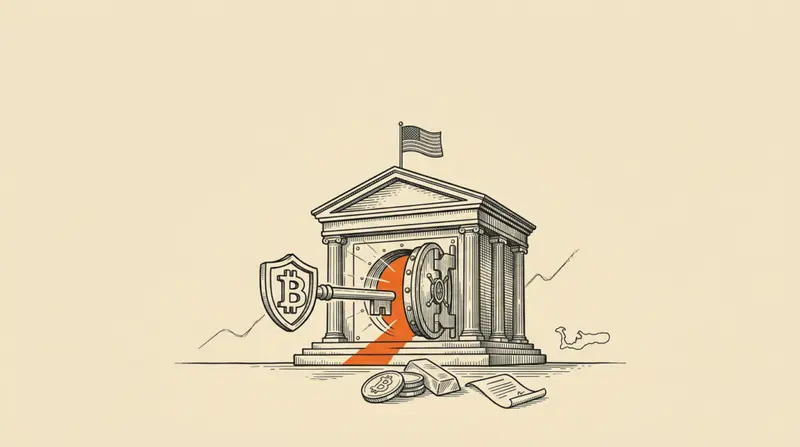
The crypto lender is migrating US clients away from the Cayman Islands, introducing trading and borrowing via a local qualified custodian.
In a market where many crypto holders prefer not to sell their coins to avoid taxes or crystallising losses, lending platforms are seeking ways to unlock liquidity without putting collateral at risk. Canadian crypto platform Ledn launched a domestic custody account for eligible clients in the United States on Tuesday 24 November. The move officially brings the firm's US operations onshore, moving away from its previous Cayman Islands structure. Through the new account, users can hold bitcoin, gold, stablecoins and US dollars, trade between them without fixed commission fees, and borrow funds using their bitcoin as collateral.
What the US custody account entails
The new service, dubbed Ledn Custody, targets individuals and enterprises seeking to unlock liquidity without parting with their digital assets. For custody and trade execution, Ledn is partnering with BitGo Bank & Trust, an independent and qualified US custodial institution. This arrangement ensures that client assets remain legally and technically segregated from Ledn's corporate balance sheet. Under the terms of the account, assets held in custody are never lent out to generate yield, marking a decisive shift from legacy crypto yield products.
Clients can execute purchases and swap across the four supported asset classes: bitcoin, gold, stablecoins and US dollars. While Ledn promotes zero per cent fixed trading fees, the company applies a 0.5 per cent spread on bitcoin purchases. According to Ledn, this spread is roughly half of what major US crypto exchanges and mobile payment apps typically charge on retail transactions. Borrowing against bitcoin enables users to draw down dollars or stablecoins for everyday liquidity or investment purposes, whilst title to the underlying bitcoin remains ring-fenced with the custodian.
Access to lending and trading features is not uniform across the United States, however. Because US legislation on lending licences and money transmission varies on a state-by-state basis, the lending offering is available at launch across a select group of states. Together, these jurisdictions represent a combined population of approximately 55 million residents. Residents of other states can currently only use the account as a custodial wallet or must wait until Ledn secures the requisite local regulatory authorisations.
From offshore structures to regulated trusts
Ledn's transition to a domestic US framework mirrors a broader structural shift across the digital asset management landscape. Since its founding in 2018, Ledn reports that it has originated more than $11 billion (approximately €10.1 billion) in loans. In its early years, the platform serviced international and American clients primarily through a Cayman Islands entity. While that offshore model provided years of operating flexibility, it met growing scepticism from users and regulatory authorities following the market turbulence of 2022.
As competitors including Celsius Network and BlockFi collapsed after reinvesting client deposits into high-risk strategies, Ledn managed to navigate the storm by adhering strictly to overcollateralised lending facilities. To reinforce institutional and high-net-worth confidence, the firm has aligned itself with regulated entities in recent years. In August 2024, Ledn secured a $50 million (roughly €46 million) loan facility from regulated Swiss digital asset bank Sygnum, backed by bitcoin collateral. In addition, stablecoin issuer Tether came onboard as a strategic shareholder in November of last year.
Ledn's transition to a domestic US framework mirrors a broader structural shift across the digital asset management landscape.
By appointing BitGo Bank & Trust as its US custodian, Ledn is seeking to eliminate concerns surrounding commingled balance sheets. In previous market failures, clients saw their claims ensnared in protracted bankruptcy proceedings when lenders faced insolvency. A structure anchored by a qualified trust bank insulates customer assets, ensuring that creditors of the lending business have no legal claim over them in the event of default.
Why borrowing against bitcoin carries downside risk
Borrowing against crypto collateral is an appealing proposition for those confident in bitcoin's long-term value, but the mechanism is not without financial risk. The collateral value fluctuates constantly. When markets slide, the loan-to-value ratio deteriorates, prompting the lender to issue margin calls requiring additional bitcoin deposits or liquidating collateral to extinguish the debt.
That risk is far from hypothetical. According to market data from Block #9 recorded on 24 November at 17:29, bitcoin traded at €54,415. That marks a 5.4 per cent decline over the preceding 24 hours, an 8.0 per cent loss on a weekly basis, and a 25.8 per cent drawdown over the past thirty days. Standing 49 per cent below its all-time high, with the Fear & Greed Index at a deeply subdued 13 out of 100 (Extreme Fear), platform margin buffers are under close scrutiny. Borrowing in such a volatile climate with thin collateral headroom leaves market participants exposed to forced liquidations at inopportune moments.
At Block #9, we observe that Ledn is catering directly to investors keen to avoid triggering taxable sales. Nevertheless, borrowers must remain acutely aware of leverage. Taking out a loan against an asset that can shed a quarter of its value within a single month demands generous overcollateralisation alongside liquid cash buffers to service potential margin calls.
What this US shift means for European readers
For crypto holders in Belgium and the Netherlands, this particular custody account is not directly accessible, as the product is structured under US law exclusively for residents of the United States. However, the move carries broader implications for European investors.
Within the European Union, the MiCA (Markets in Crypto-Assets) regime sets the operational standard for crypto-asset service providers. European clients engaging with international lending platforms frequently still do so via offshore entities located outside the EU, introducing legal uncertainty should disputes arise. Ledn's migration toward an onshore supervisory framework in the United States highlights that major CeFi (Centralised Finance) operators recognise that sustained business requires local licensing and institutional custodial arrangements. Similar regulated frameworks under European supervision will likely be required for lending platforms seeking to retain long-term market access across the continent.
Furthermore, domestic tax treatments across the Low Countries heavily influence the viability of borrowing against crypto:
- Belgium: capital gains on digital assets realised within the normal management of private wealth are broadly exempt from personal income tax. However, speculative trading or professional earnings are taxed at rates up to 33 per cent or 50 per cent. Taking out a loan using bitcoin as collateral does not constitute a disposal for tax purposes, meaning no capital gains tax is triggered, though tax authorities scrutinise structures devised purely for tax avoidance.
- The Netherlands: under Box 3, assets are subject to the wealth tax regime. Crypto holdings are categorised as other assets, but debts may, under specific conditions, be deducted from taxable net wealth. Borrowing against bitcoin expands debt obligations, which may lower the Box 3 taxable base, provided the loan satisfies all formal administrative criteria.
- Banking acceptance: transferring fiat liquidity from a foreign crypto platform into a traditional Belgian or Dutch current account continues to trigger scrutiny from mainstream banks. Without unambiguous proof of funds and documented loan agreements, domestic banks routinely halt or reject such incoming wires under anti-money laundering compliance obligations.
What we are watching at Block #9
The roll-out of Ledn Custody is not an end in itself, but the starting point for the Canadian platform's wider US onshore strategy. We believe the initiative's success will largely hinge on the speed with which Ledn secures additional state lending licences. Without regulatory clearance in high-volume states such as New York or California, its market reach remains confined to a limited segment of the US public.
In addition, Ledn has announced plans to launch gold-backed lending facilities in the coming weeks. This addition represents a notable bridge between traditional physical commodities and digital assets. Investors holding both physical bullion and bitcoin will gain the capacity to diversify collateral risk across assets with contrasting volatility profiles. The mechanics will depend heavily on how BitGo structures the physical or tokenised custody of the underlying gold and where loan-to-value requirements are pegged.
Finally, we are closely monitoring how regulators, including the US Securities and Exchange Commission (SEC) and banking supervisory bodies, respond to crypto lending models anchored by qualified trust banks. If this structure proves resilient against legal challenges and insolvencies during market stress, it may emerge as the benchmark for the digital asset lending sector. For borrowers right now, however, the primary consideration remains whether the market stays calm enough to avert painful margin calls.
- bitcoin
- bitgo
- Custody
- gold
- ledn
- borrowing
- mica
- Sygnum Bank
- tether
- United States

Written by
Amina El Yazidi
Tax Editor · Brussels (BE)
Expertise
Amina follows tax rules around crypto in the Netherlands and Belgium. She translates fiscal legal texts into practical steps for retail investors.
Related articles
- Borrowing Against Bitcoin Without Selling Becomes Possible on the Sui Network
- Lending Platform Maple Missing 400 Bitcoin in Collateral Audit, Loans Remain Covered
- PowerCompute Sells 267 Bitcoin to Clear Debt With No Guarantee of Survival
- Dolomite Adds €92m in Bitcoin Collateral, Enabling Borrowing Without Custody Risk
- Bitcoin-Backed Loans Increasingly Used for Tuition Fees and Business Capital
- Crypto Sector Gains AI Testing Ground with BitGo Labs
Stay in the loop
Follow Block #9.
Daily market and equity news in your feed. Follow us on Facebook and Instagram so you never miss an analysis.
Practice without real money or test your knowledge?
Read more




