
Europe Delays Strict Methane Rules by Two Years Under US Pressure
Block #9
Europe Delays Strict Methane Rules by Two Years Under US Pressure
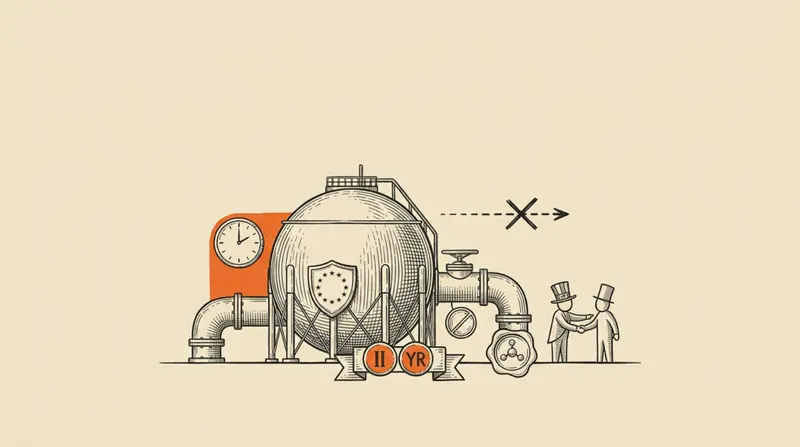
Brussels has postponed mandatory checks on methane leaks from oil and gas imports by two years, caving in to warnings over supply shortages and US trade pressure.
While European negotiators were still calling for stricter global standards at the international climate summit in Antalya, a very different scene was unfolding behind closed doors in Brussels. On Wednesday evening, the European Parliament and the Council of Ministers struck a deal to suspend the implementation of the European methane regulation by two years. Originally scheduled to take effect on 1 January 2027, the legislation required importers of natural gas, crude oil and coal to actively detect and repair leaks of the greenhouse gas methane, backed by heavy financial penalties. Following the political compromise, that obligation is now pushed back to 2029.
US shale gas exporters secure a win
The decision marks the provisional culmination of a lobbying campaign launched from Washington more than a year ago. US Secretary of Energy Chris Wright, himself a veteran of the shale gas industry, had already sounded the alarm publicly in September 2025 during meetings with European diplomats. His message to Europe left little to the imagination: anyone seeking to bring more US liquefied natural gas into European ports cannot impose stringent environmental standards that impose financial burdens on US production. According to Wright, the stringent European rules signalled that foreign energy companies were unwelcome in the European market.
That warning struck a particularly sensitive nerve. Only months before those remarks, European Commission President Ursula von der Leyen and US President Donald Trump concluded a sweeping bilateral energy agreement. In it, the European Union committed to purchasing $750 billion, roughly €690 billion, in US fossil fuels. Following the rupture with Moscow, Europe was desperately seeking stable partners to maintain its gas storage levels. However, US liquefied gas, known as LNG, is primarily extracted via hydraulic fracturing from deep shale formations. This extraction method releases substantial volumes of unburned gas directly into the atmosphere, leaving the product heavily polluting by Western environmental standards.
To comply with European import requirements, US gas producers would have had to invest hundreds of millions in monitoring equipment, infrared cameras, and repair work on wells and pipeline networks. Without those investments, European importers risked having to pass on hefty fines or simply reject shipments. The US gas lobby then threatened to reroute tankers to Asian buyers instead, where such environmental mandates do not exist. That threat ultimately proved sufficient to bring European lawmakers to a standstill.
Supply crisis fears sway member states
Alongside pressure from Washington, panic in domestic energy markets played a decisive role. Ongoing armed conflicts in the Middle East, notably the war involving the United States, Israel and Iran, once again drove wholesale gas prices sharply higher across Europe. European governments feared that strictly enforcing the methane law in 2027 would trigger acute shortages and a fresh spike in inflation for households and businesses.
Without those investments, European importers risked having to pass on hefty fines or simply reject shipments.
The European refining sector and gas importers, represented by industry bodies such as FuelsEurope, deftly capitalised on that unease. Calculations by FuelsEurope showed that as much as 43 per cent of total European gas imports and as much as 87 per cent of crude oil imports would face administrative or operational bottlenecks from 2027 if the legislation entered into force unchanged. Companies argued that the European Commission’s guidelines were drafted far too vaguely. According to them, no one knew precisely how methane leaks across foreign supply chains should be measured and reported to avoid fines.
Led by Berlin and Paris, a group of at least ten member states pulled the emergency brake. Germany, the continent’s largest gas consumer and hard-hit by a faltering industrial economy, was the first to demand a one-year postponement. France backed the move in September. Inside the European Parliament, the right-wing majority went a step further, tabling a three-year delay. During late-night negotiations, the parties ultimately met in the middle: a two-year pause, meaning penalty clauses and rigorous monitoring will not take effect until 2029.
Methane as the overlooked climate threat
The decision deals a serious blow to the credibility of European climate policy. Exactly five years ago, at the COP26 climate summit in Glasgow in 2021, the European Union and the United States launched the Global Methane Pledge with great fanfare. The pledge was clear: global methane emissions had to fall by at least 30 per cent before the end of the decade. The European methane regulation was the legislative crown jewel intended to turn that commitment into binding obligations for multinational corporations.
Methane is the main component of natural gas and is known as one of the most potent greenhouse gases. Although the gas degrades more rapidly in the atmosphere than carbon dioxide, it traps up to 80 times more heat than CO2 over a 20-year horizon. Scientists estimate that roughly 30 per cent of current global warming is directly attributable to methane. While intensive livestock farming represents the single largest source, roughly 10 per cent of total methane emissions stems from leaking pipelines, flaring and venting in the oil, gas and coal sectors.
The paradox of tackling methane in the fossil fuel industry is that detecting and repairing leaks with valves and seals is technically relatively straightforward and inexpensive. Because companies can capture and sell the escaping gas, many of these interventions pay for themselves. Yet history shows that producers rarely make these investments voluntarily in the absence of binding penalties. By suspending the regulation, one of the most effective levers for rapid climate gains remains shelved for now.
Sharp divide between industry and parliament
Reactions to the Brussels deal reflect the deep ideological rift running through European energy policy. Industry groups expressed unvarnished relief. Charlie Riedl of the Center for LNG Trade told Reuters that the breathing room goes a long way towards alleviating exporters’ acute operational concerns. Riedl was quick to add that the sector hopes for a possible third transition year if implementation guidelines still fall short in 2028.
Dimitris Tsiodras, MEP for the European People’s Party and chair of the parliamentary Environment Committee, vigorously defended the outcome. According to him, this is by no means the burial of the climate law, but a pragmatic adjustment to economic reality:
- Legal certainty: according to Tsiodras, energy companies receive the time needed to establish reliable measurement protocols with foreign suppliers.
- Security of supply: the risk that liquefied natural gas tankers avoid the European Union over looming administrative penalties is eliminated.
- Cost control: additional financial costs passed directly through importers onto the energy bills of citizens and SMEs are avoided for the time being.
On the left of the chamber, reaction was furious. Belgian Green MEP Sara Matthieu called it outright hypocrisy, criticising Europe for bowing to President Trump and fossil fuel shareholders while binding itself even more tightly to costly overseas gas contracts. European Commissioner for Climate Action Wopke Hoekstra sought to calm tempers, denying in Antalya that Europe had caved in. According to the Commissioner, the Union is simply buying time to streamline supplies without abandoning its 2030 targets.
Uncertain oversight of foreign suppliers
We would argue that with this move, Brussels primarily exposes its own geopolitical vulnerability. By relying heavily on US shale gas to replace Russian pipeline supplies following the 2022 energy crisis, Europe fundamentally weakened its environmental bargaining power. In our view, a regulatory vacuum is emerging, casting serious doubt on whether European regulators will possess the tools to hold foreign producers to account in 2029.
The lingering question in the wake of this deal is what happens if market conditions have not fundamentally improved in two years’ time. If geopolitical tensions in the Middle East persist and global demand for liquefied gas remains high, US exporters in 2028 will possess the exact same leverage as they do today. Whether the European Union will then be willing to risk potential supply disruptions in the name of methane reduction remains an open question.
- Aardgas
- donald trump
- Energievoorziening
- Europees Parlement
- Europese Unie
- klimaatbeleid
- LNG
- Methaanverordening
- United States
- Wopke Hoekstra

Written by
Noor Claeys
Research Editor · Hasselt (BE)
Expertise
Noor does data journalism and longer investigative stories. She sifts through files on exchanges, bankruptcies, and supervisory cases in Europe.
Related articles
- Heavy Industry Secures €10 Billion in Free Emission Allowances Under EU Deal
- Wall Street Surges Thirty Per Cent Following Surprise Return of Nvidia Chief Jensen Huang
- Ahead of Trump Dinner, Half of Qualifying Wallets Appear Foreign
- Dutch Planning Bureaus See Minimal Drop in Energy Costs from New EU Climate Rules
- European Gas Prices Plunge Seven Percent, Industry Continues to Struggle
- Fluxys Cannot Yet Assess Impact of Ban on Russian LNG in Zeebrugge
Stay in the loop
Follow Block #9.
Daily market and equity news in your feed. Follow us on Facebook and Instagram so you never miss an analysis.
Practice without real money or test your knowledge?
Read more
Other interesting articles

CFTC Approves Backpack, Granting Trading Platform Access to US Derivatives Market
- 02Major Banks Now Settle Bonds Round the Clock on Digital Network in Hong Kong

- 03Where Analysts Expected Profit, Henry Boot Suddenly Plunges Millions into the Red

- 04Ethereum Chooses Tried-and-Tested Security While Everyone Expected Faster Quantum Hashes

- 05Brussels Scales Up to €50 Billion for Quantum Technology and Artificial Intelligence
