
Ethereum Postpones Faster Transactions to Defend Against Quantum Computers
Ethereum
Ethereum Postpones Faster Transactions to Defend Against Quantum Computers
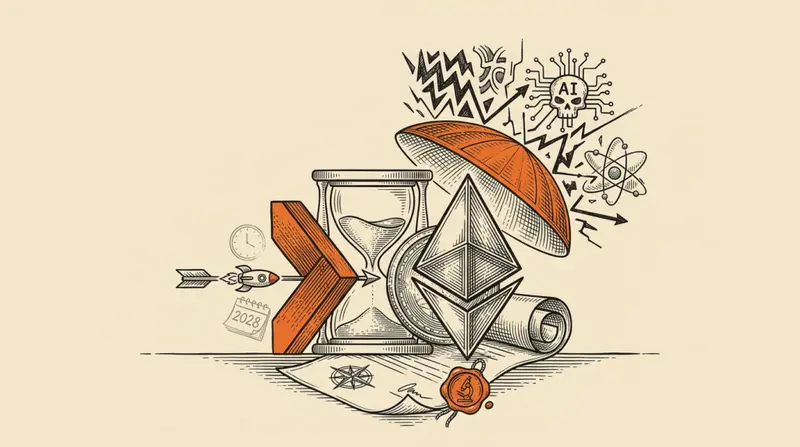
Research centre Ethlabs has pushed faster block times back to 2028, urging developers to focus all computing resources on defence against quantum and AI attacks.
Ten seconds instead of the customary twelve: that acceleration of transactions on the Ethereum blockchain has been put on ice for now. Research centre Ethlabs is withdrawing its proposal for so-called Quick Slots from the planned Hegotá network upgrade. The organisation wants to encourage developers to dedicate all available resources to a far more fundamental threat: the rise of quantum computers and artificial intelligence capable of breaking existing cryptography. While users and exchanges were banking on faster settlement times, priority has now shifted entirely to digital resilience.
The move highlights just how stark the choices have become within the world's largest smart-contract ecosystem. While rival blockchains such as Solana and Avalanche compete aggressively on transaction speed and minimal latency, the core of Ethereum research is decisively prioritising armour over acceleration. Ethlabs calls the initiative ‘pqai27’ and is targeting a baseline level of protection by 2027. That means the planned cut to ten-second blocks will not return to the agenda until 2028 at the earliest.
What Quick Slots were designed to solve
To understand what changes for those active on the chain, one must look at how the network operates. Today, Ethereum produces a new block of data every twelve seconds. Within that window, validators assemble and verify hundreds of transactions at once. For decentralised exchanges and automated traders, that twelve-second gap is a persistent source of friction. In that timeframe, the market price of a token on other venues can already shift, exposing users to price discrepancies known as slippage.
The Quick Slots proposal, set out in EIP-8198 and co-designed by researcher Barnabé Monnot, aimed to shorten that interval to ten seconds. In addition, it would give the protocol the flexibility to adjust block times further down the line without immediately requiring a disruptive hard fork of the network. For traders, it promised welcome relief. In a previous survey conducted by Ethlabs, 0xngmi, founder of data analytics platform DefiLlama, explained that shorter block times enable liquidity providers to quote significantly tighter spreads. When exchange rates diverge less between consecutive blocks, the risk of transactions being executed at an adverse price is reduced.
That friction is now here to stay for the time being. Those trading assets on decentralised exchanges will continue to rely on arbitrageurs and sophisticated bots to smooth out price gaps between blocks. By dropping Quick Slots from the Hegotá proposal, Ethlabs is consciously accepting this economic inefficiency for longer, in favour of the underlying network's security.
The Quick Slots proposal, set out in EIP-8198 and co-designed by researcher Barnabé Monnot, aimed to shorten that interval to ten seconds.
The vulnerability of cryptographic signatures
The rationale behind this strategic shift lies in the rapid progress of quantum technology. Ethereum's current architecture relies on elliptic-curve cryptography to verify digital wallet ownership and authorise transactions. Once a sufficiently powerful quantum computer becomes reality, Shor's algorithm could theoretically unravel that mathematical encryption. Bad actors could then use a user's public key to derive the corresponding private key and drain their wallets.
Ethlabs therefore wants Ethereum to be ‘pqai-ready’ by 2027. That term does not necessarily mean the network must have fully migrated to heavier quantum-safe standards, but rather that an operational emergency exit is available for every user account. Should classical cryptography fail unexpectedly, the network could switch into a secure contingency mode. In that scenario, Ethereum would temporarily operate at reduced capacity, but user funds would at least remain safe. Only after that, as a longer-term goal, would data storage and transaction processing transition to full-scale quantum resistance.
Under the ‘post-AI’ banner, the lab is also addressing more than just advanced mathematical decryption methods; it is targeting artificial intelligence that automatically hunts for bugs in Ethereum's client software. Dozens of independent teams maintain these clients, such as Geth, Nethermind and Besu. If an AI model were to uncover an unknown vulnerability in the logic used to validate transactions, a single malicious transaction could theoretically crash a substantial share of all validators.
Debate over Foundation timelines
Ethlabs' ambitious target of achieving readiness by 2027 clashes with earlier estimates from other heavyweights in the ecosystem. Justin Drake, a researcher at the Ethereum Foundation, previously suggested that a full transition to a quantum- and AI-resilient network would only be feasible around December 2028. The Foundation's official post-quantum team went even further in a June 2026 estimate: in their view, the necessary base-layer adjustments will take until 2029, after which the full migration of the execution layer will take several more years.
To make the accelerated path to 2027 feasible, Ethlabs also wants to trim other components from the Hegotá proposal. The Frames design element (EIP-8141) should be retained, as it allows wallets to determine how transactions are signed, paving the way for post-quantum signatures directly at account level. By contrast, the research centre is calling for FOCIL (EIP-7805)—a mechanism designed to enforce censorship resistance via validator committees—to be temporarily reconsidered if it threatens the security deadline.
Without FOCIL, wallet updates could be rolled out more quickly, decoupled from the heavy consensus changes required for validators. However, that approach faces scepticism within the developer community. Core developer Potuz stressed in a recent technical analysis that a meaningful transition hinges on firm specifications, dedicated software developers and a shared testnet. Without those foundations, no one can guarantee that any design will run smoothly on a predetermined date.
What this means for savers and investors
For ordinary ether holders, this postponement brings no practical changes in the near term. Transactions will continue to be processed in an average of twelve seconds, just as they are today. There is currently no acute threat; no quantum computer or AI application has actually cracked Ethereum's existing cryptography. The debate is strictly about proactive policy for the years ahead.
Even so, market participants are keeping a close eye on the technical roadmap. On 11 November at 22:32, the price of Ethereum stood at 1,875 euros, a modest 24-hour gain of 1.7 per cent, but down 13.5 per cent over the past seven days and 17.4 per cent over the last month. That leaves the token 56 per cent below its all-time high. While investors had hoped last year for rapid scaling milestones that would immediately make the network more attractive to active traders, this strategic pivot demonstrates that technical stability and security take precedence over quick performance wins.
In our view, Ethlabs' decision is technically sound, but economically a bitter pill for those hoping for faster transaction settlement. According to recent ecosystem data, Ethereum secures more than 153 billion dollars in stablecoins and, with over 58 billion dollars in total value locked, accounts for roughly 65 per cent of the global DeFi sector. Managing that volume of capital demands absolute certainty in the underlying foundations; a single cryptographic flaw would prove fatal to institutional confidence.
The coming months will show whether the wider community of core developers endorses Ethlabs' guidance during regular All Core Devs calls. The official scope of Hegotá (EIP-8081) leaves all options open. Developers thus face the classic blockchain dilemma: continue chipping away at day-to-day transaction friction, or commit valuable engineering hours now to building a defensive wall against the technology of the next decade.
- Artificial Intelligence
- Cryptografie
- defi
- EIP-8141
- EIP-8198
- Ethereum
- Ethlabs
- Hegotá
- quantum computing
- Quick Slots

Written by
Dani Oosterhuis
Payments Editor · Groningen (NL)
Expertise
Dani follows stablecoins, payment rails, and the bridge between euros and on-chain money. He tests payment solutions himself and measures costs and speed.
Related articles
- Following Recent Price Drops, BTCS Sells Ether at a Loss to Shore Up €59 Million Loan
- Researchers Link Suspicious €42m Ethereum Position to UXLink Hack
- Ethereum Foundation Doubles Security Team, Flagging Artificial Intelligence as Urgent Risk
- Europol Warns Quantum Computers Pose Primary Threat to Crypto Wallets
- StarkWare Reduces Computational Power Needed for Quantum-Safe Bitcoin by 79 Percent
- Researchers Propose Method for Enhanced Bitcoin Privacy Without Network Modification
Stay in the loop
Follow Block #9.
Daily market and equity news in your feed. Follow us on Facebook and Instagram so you never miss an analysis.
By 7 a.m. you already know
Every Monday, Wednesday, Friday and Sunday morning at 07:00, the overview in your inbox.
Practice without real money or test your knowledge?
Read more
Other interesting articles

CFTC Approves Backpack, Granting Trading Platform Access to US Derivatives Market
- 02Major Banks Now Settle Bonds Round the Clock on Digital Network in Hong Kong

- 03Where Analysts Expected Profit, Henry Boot Suddenly Plunges Millions into the Red

- 04Ethereum Chooses Tried-and-Tested Security While Everyone Expected Faster Quantum Hashes

- 05Brussels Scales Up to €50 Billion for Quantum Technology and Artificial Intelligence
