
Chinese Man Destroys Government Building With Excavator After Prolonged Financial Dispute
Block #9
Chinese Man Destroys Government Building With Excavator After Prolonged Financial Dispute
In 4 slidesThe gist of this article, fast
- 01
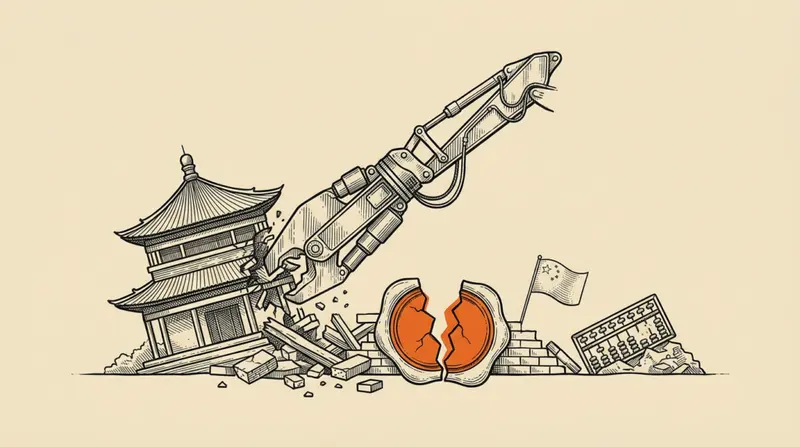
Chinese man destroys government building with excavator after prolonged financial dispute
In Xi’an, a citizen demolishes an administrative centre using hydraulic shears.
BLOCK #9 · block9.net - 02
After months of mounting frustration, a 47-year-old…
After months of mounting frustration, a 47-year-old man decided to take the law into his own hands when official complaint channels regarding his compensation failed to yield any progress.
BLOCK #9 · block9.net - 03
Billions in unpaid debt stall development
Across from the wrecked office, a planned 100-storey skyscraper has sat idle for over two years while responsible local state-owned firms face 3.7 billion yuan in overdue debt.
BLOCK #9 · block9.net - 04
Surging protests reflect economic strain
Freedom House recorded 5,343 protests in China last year. That 44% surge was driven largely by construction labourers demanding back pay.
BLOCK #9 · block9.net
In Xi’an, a citizen demolishes an administrative centre with hydraulic shears. Behind the protest lies a property crisis leaving local governments in a financial bind.
After months of mounting frustration, a 47-year-old man decided to take the law into his own hands when official complaint channels regarding his compensation failed to yield any progress. Identified by the authorities solely by his surname, Hu, the Chinese national drove a heavy excavator directly into the administrative heart of his district on Monday morning. Only after a full sixty minutes of the machine crushing metal and glass unhindered did local police finally intervene.
The incident occurred on Monday 9 November, shortly after 11:00 in the morning. The scene was the newly opened Fengdong service centre, a vast development zone on the western edge of Xi’an. Where citizens normally queue for building permits, title deeds and civil certificates, Hu suddenly sank the hydraulic shears of his yellow tracked excavator into the canopy. The steel awning collapsed immediately, followed by the systematic pulverisation of the official sign, the glass entrance facade and the brick staircase. Officials evacuated visitors through the rear while dozens of passers-by filmed the scene. No one was injured, but the symbolic damage was immense.
Property fury and unpaid bills on the outskirts of Xi’an
The police's official statement did not arrive until close to midnight and comprised a mere four short sentences. Police only confirmed that Hu had been arrested and that criminal coercive measures had been imposed—a legal term in China ranging from strict detention to electronic house arrest. The communiqué remained entirely silent on the motive. Off the record, local officials stated that Hu was furious over the meagre financial compensation he received for the expropriation and demolition of his farm. At the same time, another narrative circulated on Chinese social forums: Hu had allegedly worked as an independent crane operator on a nearby construction project and had been waiting months for back pay.
Both explanations point directly to the same underlying festering sore: the deep malaise across the Chinese property sector. Fengdong was conceived as an ultra-modern urban district, yet right opposite the wrecked office looms the concrete shell of a planned 100-storey skyscraper. The construction site has stood completely idle for more than two years. Ahead of the summer, the group of local state-owned enterprises responsible for the zone disclosed that it faces 3.7 billion yuan in overdue debt, equivalent to nearly half a billion euros. When contractors and local authorities run out of money to pay suppliers, the cash flow inevitably dries up for the man operating the excavator.
The censorship machine and the lone-wolf myth
Within hours of the incident, the Communist Party's internet censorship swung ruthlessly into action. Videos filmed by bystanders on their smartphones vanished at breakneck speed from platforms such as WeChat, Weibo and Douyin. On foreign platform X, accessible in China only via virtual private networks, the footage garnered more than 1.9 million views via the account of an exiled Chinese dissident. By the time foreign media outlets reported on the incident, domestic internet searches for the service centre's name returned only official administrative notices.
Both explanations point directly to the same underlying festering sore: the deep malaise across the Chinese property sector.
On Chinese forums, Hu was quickly compared to prominent lone figures from the past, such as Peng Lifa. In October 2022, Peng hung banners from Beijing's Sitong Bridge openly attacking Covid policy and party leader Xi Jinping, after which he disappeared and, according to human rights organisations, was secretly sentenced to nine years in prison last year. Yet the action in Xi’an differs fundamentally from politically motivated resistance. Hu targeted no ideology; he demanded material justice. His action struck a chord with many because millions of Chinese households have endured similar experiences in recent years with failing construction companies, worthless promises and demolished family homes.
The censorship here serves not only to save face, but primarily to prevent chain reactions. Above all, the Chinese government fears that angry citizens across different cities might identify patterns and connect with one another. As sinologist Rogier Creemers of Leiden University points out, Beijing wants at all costs to prevent local frustrations from coalescing into a nationwide network. Local protests are tolerated as long as they remain isolated, but anyone seeking to bridge provincial borders signs their own warrant.
Data exposes simmering social unrest
Although Beijing has refused to publish official statistics on social unrest for two decades, external monitors show that incidents like the one in Xi’an are far from isolated. US human rights organisation Freedom House recorded 5,343 separate protests in China last year, representing a daily average of nearly 15 incidents. That figure marked a 44% increase on the previous year, the sharpest rise since tracking began in 2022.
The breakdown of these protests reveals where the economic pressure points lie:
- Labourers and construction workers: Together account for almost half of all recorded actions, with unpaid wages and sudden employer bankruptcies by far the primary grievances.
- Property owners: Citizens protesting against developers abandoning unfinished flats or refusing to pay promised compensation following forced relocations.
- Farmers and rural residents: Targeting local cadres who requisitioned farmland at rates well below fair market value.
Since February, the internet supervisory authority has sought to stem the flow of incidents more aggressively through a large-scale government campaign targeting anyone stoking negative sentiment on social networks. Research by Freedom House revealed that of nearly 3,000 tracked protest clips on Douyin, two-thirds had been erased without a trace within months. For footage showing citizens attempting to lodge an official petition, the censorship rate reached as high as 80%. Those who cannot be seen cannot inspire others, goes the logic of the party leadership.
Why buying social peace is failing today
Historically, local administrators relied on two levers to maintain order: heavy-handed police repression or simply buying off the aggrieved party. Chinese mayors and party secretaries are judged directly by the central leadership on the absence of public scandals. In the past, when an angry citizen threatened to travel to Beijing to petition the central complaints bureau, district administrations often paid hush money from the municipal coffers. On occasion, hired thugs were even deployed to literally pluck petitioners off trains bound for the capital.
That payoff model has now broken down due to an acute shortage of cash. Provinces and cities previously generated up to half of their total budgetary revenues from auctioning development land to commercial developers. With the ongoing property crisis, those land sale revenues have plunged by more than 50% since their 2021 peak. Local governments are saddled with a colossal mountain of debt, completely wiping out the financial buffer once used to compensate citizens. The excavator operator in Fengdong collided with an administration that simply no longer possesses the funds to settle its mounting bills.
Four days after the destruction, dozens of police officers stood guard outside the restored building in Xi’an. The debris had been cleared behind wooden hoardings, and inside, citizens once again queued meekly to pay their taxes. This enforced normality leaves a fundamental question unanswered: what does an authoritarian system do when the money to purchase social peace has finally run out?
- censuur
- China
- Fengdong
- Freedom House
- Peking
- Protest
- schulden
- vastgoed
- Xi Jinping
- Xi'an

Written by
Dani Oosterhuis
Payments Editor · Groningen (NL)
Expertise
Dani follows stablecoins, payment rails, and the bridge between euros and on-chain money. He tests payment solutions himself and measures costs and speed.
Related articles
- China Retail Sales Growth Slumps to 0.4% as Hopes for Acceleration Fade
- New World Development Shareholders Face Massive Dilution Following Capital Hike
- Chinese Consumers Spend More Cautiously as Inflation Cools to 0.7 Percent
- Xior Sees Occupancy Peak as Earnings Rise to €74 Million
- Xi Jinping Boosts Global Ambitions: Artificial Intelligence & BRICS Redefine World Order
- Japan Faces a Debt Crisis: Global Economic Warning
Stay in the loop
Follow Block #9.
Daily market and equity news in your feed. Follow us on Facebook and Instagram so you never miss an analysis.
Practice without real money or test your knowledge?
Read more




