Argentine Central Bank Informally Targets USDT Transactions
Tether (USD-T)
Argentine Central Bank Informally Targets USDT Transactions
In 4 slidesThe gist of this article, fast
- 01
Argentine central bank informally targets USDT transactions
As trading volumes around the peso surge, the central bank is informally urging crypto firms to exercise caution regarding transactions between…
BLOCK #9 · block9.net - 02
Central bank targets MEP dollar and USDT trades
Regulators quietly asked crypto platforms to monitor trades between MEP dollars and Tether. Officials fear the arbitrage loop will pressure the fragile peso.
BLOCK #9 · block9.net - 03
Parliament bans money printing for the treasury
Under President Javier Milei, lawmakers ended 91 years of central bank financing. The measure cleared the lower house without opposing votes, while 99 MPs abstained.
BLOCK #9 · block9.net - 04
Peso crypto trading volume jumped 400 percent
Crypto trading against the Argentine peso rose 400 percent earlier this year. Savers increasingly turn to USDT to bypass currency controls without carrying cash.
BLOCK #9 · block9.net
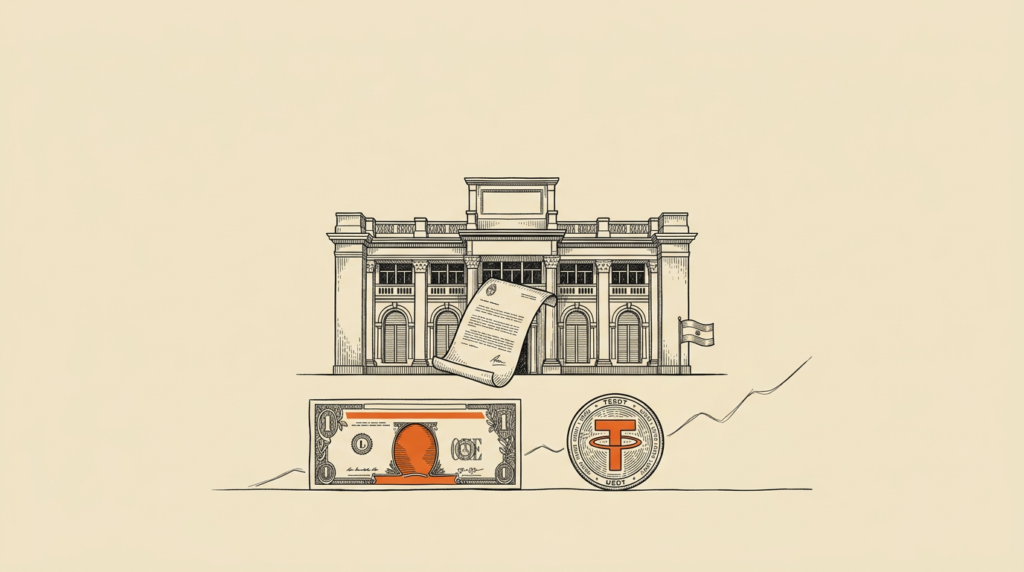
As trading volumes around the peso surge, the central bank is informally urging crypto firms to exercise caution regarding transactions between regulated dollars and Tether.
In the streets and trading houses of Buenos Aires, the pursuit of stable dollars has become a daily reality. The Argentine central bank has recently made informal contact with several digital wallet providers and crypto exchanges to issue recommendations on trading between the so-called MEP dollar and the stablecoin USDT. According to industry executives, this was not a formal decree or a binding resolution, but rather discreet hints dropped behind closed doors. Despite these regulatory nudges, trading on the platforms has continued at its usual pace for now, without direct disruptions for end users.
Informal warnings behind the scenes
The monetary authorities' concerns centre on the bridge between traditional financial markets and the crypto ecosystem. The MEP dollar—short for Mercado Electrónico de Pagos—is a fully legal mechanism allowing Argentines to acquire US dollars within the banking system through the purchase and sale of government bonds. Those who subsequently convert these dollars into Tether circumvent part of the stringent capital controls that have gripped the country for years. Executives confirmed to local media outlet iProUP that regulators are now closely monitoring financial flows between these two channels. The central bank fears that significant arbitrage spreads will put pressure on the exchange rate and further erode the already fragile peso.
That the supervisory authority is opting for informal recommendations rather than an outright ban is a tried-and-tested tactic in the country. A formal circular often triggers panic on the black market, instantly driving up the price of the informal or blue dollar. By quietly approaching individual management teams, the authorities are attempting to prompt platforms into voluntarily implementing extra checks or slowing down large transactions. For now, however, this has caused no operational disruptions: exchanges and wallet providers unanimously confirm that deposits, conversions and withdrawals are being processed as normal.
Monetary reforms under Milei's administration
The central bank's intervention comes at an exceptionally delicate moment in President Javier Milei's macroeconomic roadmap. Parliament recently passed legislation strictly prohibiting the central bank from printing further money to fund the treasury or extending loans to the debt-laden state. The measure cleared the lower house without any opposing votes, though 99 MPs abstained. While Milei loudly promised during his election campaign to abolish the institution entirely, the reform was watered down: the institution will remain, but with the sole statutory mandate of defending the value of the peso.
That the supervisory authority is opting for informal recommendations rather than an outright ban is a tried-and-tested tactic in the country.
The financial spigot to government ministries has thus been turned off after what the presidential cabinet characterised as 91 years of plundering since the bank's founding in 1935. At the same time, the real economy is teetering on the brink of a technical recession, with economic activity contracting in the second quarter and early third-quarter data pointing to a further downturn. As the government tightens monetary discipline, citizens are seeking breathing room outside the traditional banking system. The divide between official policy intentions and the actions of citizens looking to hedge against currency depreciation is becoming more tangible by the day.
Why Tether became the flight-to-safety asset of choice
To understand why the central bank is specifically targeting the link between the MEP and USDT, one must consider the massive wave of digital dollar adoption across the South American nation. Earlier this year, crypto trading volumes against the Argentine peso recorded a 400 per cent increase compared to previous periods. For millions of Argentines, Tether effectively serves as a more practical alternative to physical cash banknotes, which must be stored and transported physically. While exchanging cash dollars on the street carries security risks, acquiring USDT via an app takes only seconds.
When traders spot a price discrepancy between the regulated MEP rate and USDT prices on crypto exchanges, a profitable arbitrage flow emerges. Investors buy bonds in pesos, sell them for official dollars on the securities exchange, convert those into USDT, and sell the tokens back for pesos at a higher parallel rate. This loop circulates liquidity that regulators would far prefer to keep inside traditional savings accounts. It illustrates the extent to which cryptocurrencies in inflationary economies have become interwoven with everyday financial management, well beyond mere speculative trading.
Implications for international crypto markets and Europe
The situation in Argentina highlights how monetary restrictions and crypto adoption interact—a dynamic that also provides valuable lessons for regulators in Brussels and Frankfurt. While these specific exchange rate mechanisms are characteristically Argentine, European investors view such markets as stress tests for stablecoins under extreme conditions. While Europe's MiCA regime imposes stringent requirements on the reserves and reporting of issuers such as Tether and Circle, Latin American reality demonstrates that real-world demand for dollar-pegged tokens is frequently driven by the sheer survival instincts of savers and businesses.
On the global stage, market sentiment remains deeply cautious. Block #9 market data recorded on 24 November at 17:29 shows the Fear and Greed Index deep in extreme fear territory, with a score of 12 out of 100. At the same time, Bitcoin traded at 54,415 euros, down 8.0 per cent over seven days and 25.8 per cent over the past thirty days. This illustrates that while the broader crypto market suffers under macroeconomic headwinds and risk aversion, the utilitarian adoption of stablecoins in countries experiencing currency turmoil continues apace autonomously.
What lies ahead?
The central bank finds itself in an exceptionally tricky position. We believe the current informal pressure is primarily a temporary effort to buy time without rattling financial markets. The critical question remains what the authorities will do if trading platforms ignore these non-binding warnings. Should lawmakers step in with enforceable decrees, history risks repeating itself: liquidity will simply migrate to peer-to-peer channels and informal over-the-counter desks that lie entirely beyond regulatory sight.
The industry is keeping a close watch on the monetary policy team's next moves. The coming months will reveal whether the central bank formalises its oversight through official circulars for virtual asset service providers, or whether sustained economic contraction forces the government to ease currency trading controls instead. Until macroeconomic stability is firmly restored, the interplay between bond-derived dollars and stablecoins will remain a persistent flashpoint across Buenos Aires' financial markets.
- Argentinië
- centrale bank
- Javier Milei
- Latin America
- MEP-dollar
- regulation
- Stablecoins
- tether
- usdt
- Valutamarkt

Written by
Sanne Vermeulen
Market editor · Amsterdam (NL)
Expertise
Sanne monitors crypto markets, ETF flows, and institutional inflows in Europe. She previously wrote about capital markets and translates market data into understandable stories.
Related articles
- Tether Freezes Billions in Stolen Crypto Within Minutes, but Victims Wait Years for Recovery
- Paraguayan Savers Pay 13% Premium for Tether Following Ueno Closure
- Brazilians Gain Easier Access to Digital Dollars Following €14 Million Investment
- Tether Founder Jean-Louis van der Velde Tops Quote 500 for First Time
- Senator Blumenthal Demands Answers From Tether Over Payments to Former White House Adviser
- TRON Network Demands Up To 13 TRX For Account-Free USDT Transfers
Stay in the loop
Follow Block #9.
Daily market and equity news in your feed. Follow us on Facebook and Instagram so you never miss an analysis.
By 7 a.m. you already know
Every Monday, Wednesday, Friday and Sunday morning at 07:00, the overview in your inbox.
Practice without real money or test your knowledge?
Read more