
Eight Years After Launch, €280 Million Must Leave Zcash Privacy Pool
Crypto News
Eight Years After Launch, €280 Million Must Leave Zcash Privacy Pool
In 4 slidesThe gist of this article, fast
- 01
Eight years after launch, €280 million must leave Zcash privacy pool
Zcash developers want to accelerate the halt of deposits into the legacy Sapling system over fears that breakthroughs in artificial intelligence…
BLOCK #9 · block9.net - 02
€280 million must leave the Sapling pool
Development team Zakura is urging users to withdraw roughly 400,000 ZEC immediately. That capital accounts for nearly two percent of the circulating supply.
BLOCK #9 · block9.net - 03
Fears rise that AI could break cryptography
Developers Sean Bowe and Dev Ojha warn that advances could crack bilinear pairings. If compromised, attackers could forge transaction proofs or print new coins undetected.
BLOCK #9 · block9.net - 04
Funds shift to the newer Ironwood system
Ironwood already holds about 85 percent of all shielded ZEC. Its Halo 2 architecture relies on mathematical formulas immune to the specific exploit threatening Sapling.
BLOCK #9 · block9.net
Zcash developers want to accelerate the halt of deposits into the legacy Sapling system over fears that breakthroughs in artificial intelligence could crack its cryptography.
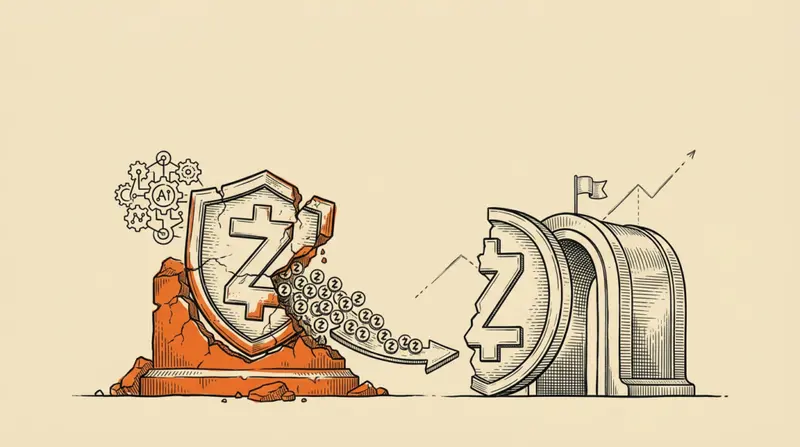
What happens when the mathematical foundations underpinning an established privacy coin suddenly age faster than expected? The answer came this week from Zcash development team Zakura, which is urgently calling on users to withdraw approximately 400,000 ZEC—worth nearly €280 million—from the legacy Sapling pool as quickly as possible. According to lead developers Sean Bowe and Dev Ojha, rapid advancements in artificial intelligence and sophisticated computing power make it theoretically plausible that the underlying cryptography could be compromised. To prevent attackers from stealthily minting new coins, the team proposes fast-tracking a ban on new deposits into Sapling, leaving only withdrawals operational.
Vulnerable mathematical formulas and the risk of counterfeiting
The concern centres on how Zcash shields transactions from outside scrutiny. While public networks such as Bitcoin openly record sender, recipient and amount on the ledger, Zcash relies on advanced cryptographic proofs. When a transaction takes place, the wallet mathematically proves that the sender controls the funds and respects protocol rules without disclosing the underlying transaction details. The Sapling pool, launched in 2018 to make shielded transactions significantly faster and lighter, relies on bilinear pairings. This mathematical shortcut enables nodes to verify a proof in a fraction of a second. However, its security hinges entirely on the premise that the underlying calculations are uncrackable by any classical computer.
Zakura fears that this premise is nearing its expiration date. If mathematicians or autonomous AI systems succeed in theoretically breaking such pairings, bad actors could forge valid transaction proofs. An attacker could then execute payments approved by the network or even print brand-new ZEC out of thin air. Because figures within a shielded privacy system remain hidden by design, such counterfeiting would be virtually impossible to detect while the capital remains inside the pool. The fraud would only come to light once someone attempted to withdraw more coins than had ever been deposited throughout the pool's history.
The developers stress that no functional attack on Sapling has been demonstrated to date. The heightened state of alert stems from recent rumours regarding academic claims, including alleged AI-assisted proofs for complex prime number problems. Although practical breakthroughs in this area remain speculative for now, Zakura is taking no chances. Waiting for an exploit to become public knowledge would mean bad actors could drain the network long before anyone could intervene.
If mathematicians or autonomous AI systems succeed in theoretically breaking such pairings, bad actors could forge valid transaction proofs.
From voluntary exodus to an emergency shutdown
The proposal now on the table outlines a two-phase network upgrade. Initially, developers want to disable all new deposits into Sapling, while leaving withdrawals to the newer Ironwood system fully functional. This approach allows activity in the older pool to wind down gradually without locking users out of their assets. If a credible threat or concrete attack were to emerge in the interim, the community could instantly trigger a total freeze of the Sapling pool. A timely freeze would preserve balance accounting intact, allowing legitimate owners to recover their funds at a later stage once a new proof system is deployed.
The timing of this warning is no coincidence. Discussions surrounding the decommissioning of Sapling began as early as April 2026, when Dev Ojha proposed on the community forum that the pool be placed into sunset mode. The current appeal significantly accelerates that timeline, though a definitive activation date is yet to be established. According to network data, roughly 376,000 to 400,000 ZEC remains in Sapling, representing nearly two percent of the cryptocurrency's total circulating supply. With the market price hovering around €690 per ZEC, this represents substantial capital that must now be mobilised.
The more modern counterpart, Ironwood, which already holds roughly 85 percent of all shielded ZEC, faces no danger from potential mathematical breakthroughs targeting pairings. Ironwood relies on the Halo 2 system, a cryptographic architecture designed entirely without such pairings. Halo 2 builds upon a simpler mathematical framework that is immune to the specific exploit methods to which Sapling could prove vulnerable. Public Zcash transactions also remain unaffected, as they contain no shielded proofs and remain openly verifiable on the blockchain.
What the security shift means for Belgian and Dutch holders
For cryptocurrency holders in the Low Countries with Zcash exposure, this situation calls for targeted action and vigilance. Those holding their ZEC on a centralised crypto exchange typically use transparent addresses and will notice little from the underlying pool modifications. Most European crypto exchanges ceased supporting direct deposits from shielded addresses long ago due to strict anti-money laundering legislation. However, those using the asset as intended—for financial privacy via a self-custody wallet—must verify which address format holds their funds.
- Address verification: check in your wallet software whether your assets are held at an address starting with ‘zs’, indicating a Sapling address, and transfer those coins to a modern ‘u’ address within the Ironwood or Orchard ecosystem.
- Crypto exchanges: holders storing coins on regulated platforms in Belgium or the Netherlands do not need to execute transactions themselves, though they may encounter temporary withdrawal pauses while exchanges synchronise their internal custody systems.
- Transaction fees: manually transferring between the different shielded network layers costs only a fraction of a euro cent in network fees, but requires updated wallet software supporting the latest cryptographic standards.
For the wider market, this technical alert arrives at a fragile juncture. Crypto investor sentiment has remained extremely depressed for some time. On 24 November at 17:29, the Block #9 Fear and Greed Index stood at 11 out of 100, indicating extreme fear in the market. Bitcoin was trading at €54,415 at that exact reading, down 25.8 percent over thirty days and 49 percent below its all-time high. In a market environment characterised by scarce liquidity and dominant risk aversion, any rumour of cryptographic uncertainty in legacy protocols risks creating additional selling pressure across specific altcoins.
Structural vulnerabilities continue to haunt the privacy coin
Taking a broader view of Zcash history reveals a pattern where privacy preservation continually clashes with the complexity of cutting-edge technology. The move to expedite Sapling's phase-out follows a string of previous incidents highlighting the fine line between airtight anonymity and network-threatening flaws. On 3 June this year, developers were forced into an emergency halt of transactions in the Orchard pool following the discovery of a critical security vulnerability. That bug was patched within hours via an emergency soft fork, with the Zcash Foundation stating there was no evidence of exploitation, yet the incident underscored once again how vulnerable advanced zero-knowledge cryptography remains in practice.
Earlier, the network carried out the NU7 upgrade to permanently lock down spending from the original Sprout pool. The fact that Zakura must once again push to shut the back door on an older generation shows that privacy networks carry considerable technical debt. What stands out is how the emergence of specialised AI models is drastically shortening the lifespan of traditional cryptographic assumptions. What was considered unbreakable mathematics for decades to come in 2018 is viewed just eight years later as an untenable risk.
The proposed migration appears to be the technically sound course of action, yet organisationally it presents a formidable stress test for the Zcash community. A network where a significant portion of users deliberately choose anonymity does not lend itself easily to centralised coordination for a capital migration. The coming months will show whether the remaining €280 million flows smoothly into Ironwood, or whether developers will be forced to pull the emergency brake and freeze the legacy privacy pool once and for all.
- Artificial Intelligence
- Cryptografie
- Dev Ojha
- Ironwood
- privacy
- Sapling
- Sean Bowe
- Zakura
- zcash
- zec

Written by
Veerle Janssens
Institutional Editor · Bruges (BE)
Expertise
Veerle spoke with asset managers and pension funds for years. She writes about institutional adoption, custody, and risk management.
Related articles
- Zcash Promises Fast Anonymous Payments While Initial Blocks Still Falter
- Brussels Scales Up to €50 Billion for Quantum Technology and Artificial Intelligence
- Crypto Payments Sector Faces Heightened Fraud Risks Following Gnosis Pay Data Breach
- Zcash Aims to Make Public Payments Quantum-Resistant by January
- Researchers Propose Method for Enhanced Bitcoin Privacy Without Network Modification
- Zcash Holders Vote Overwhelmingly for Faster Transactions and Current Halving Schedule
Stay in the loop
Follow Block #9.
Daily market and equity news in your feed. Follow us on Facebook and Instagram so you never miss an analysis.
Practice without real money or test your knowledge?
Read more




