Abu Dhabi Freezes Over €6 Billion in Assets Following Binance Theft
Crypto Exchanges
Abu Dhabi Freezes Over €6 Billion in Assets Following Binance Theft
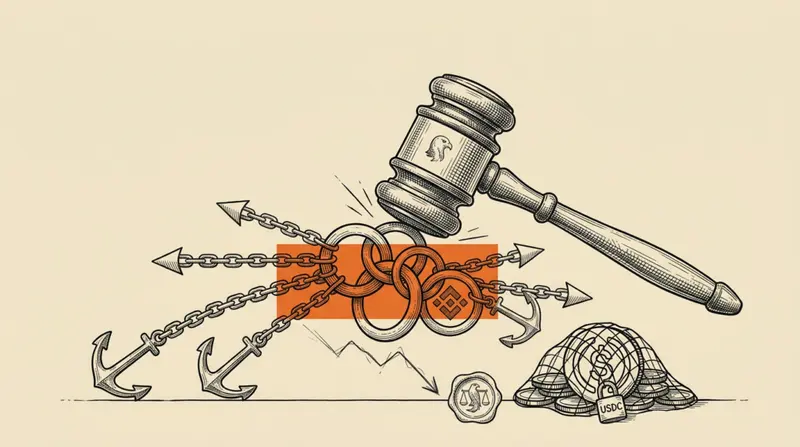
A commercial court in Abu Dhabi has issued a worldwide freezing order on up to $6.5 billion in cryptocurrencies following the record-breaking Binance breach on 29 October.
Crypto exchanges, custodians, and stablecoin issuers worldwide must immediately isolate tens of thousands of digital wallets to sever the cash flows of an unprecedented theft. That obligation stems from a ruling by the court of the Abu Dhabi Global Market (ADGM), which granted a worldwide freezing order for up to $6.5 billion—equivalent to nearly €6.2 billion—at the request of trading platform Binance. The order targets the as-yet-unidentified perpetrators of the massive breach that struck the platform on 29 October. The objective of this legal intervention is unequivocal: to prevent stolen assets from leaking further through intermediaries whilst investigators and lawyers work to track the trail and secure the loot.
The ruling deploys serious legal firepower against a network operating covertly across the blockchain. The injunction not only imposes a blanket asset freeze, but also pairs it with proprietary and delivery-up orders for specific funds. According to law firm Gibson Dunn, which is representing Binance in these proceedings, market participants have been served with a dynamic list of approximately 26,000 distinct wallet addresses directly tied to the heist. This list is continuously updated as stolen funds migrate to new destinations. Eighteen companies, including USDC issuer Circle and decentralised platform World Liberty Financial, were ordered by the court to maintain existing blocks and under no circumstances lend out, swap, or commingle the crypto assets in question with other fund flows. The court expressly stressed that these intermediaries themselves are not suspected of any wrongdoing.
A wide gulf between freezing and actual recovery
Although the granted sum of $6.5 billion appears staggering, the court ruling by no means implies that billions of euros have been instantaneously recovered. The figure constitutes a legal ceiling for the injunction, rather than a bank balance restored to the exchange’s books. Figures from blockchain intelligence firm Elliptic reveal that approximately $2.85 billion has been successfully frozen or seized to date, representing around 44 per cent of the total haul. Elliptic estimates the overall scale of the breach at $6.43 billion, whilst Binance itself previously put the compromised sum at $6.34 billion. A substantial portion of the assets therefore remains locked firmly in the crosshairs of regulators and investigators.
Shortly after the cyberattack on 29 October, stablecoin issuer Circle moved swiftly to freeze approximately $823 million in USDC directly. Tether, the issuer behind USDT, was not included among the eighteen entities named in the court order. The company had previously blocked roughly $1.5 billion in USDT on its own initiative and stated that it is collaborating directly with Binance and competent authorities to assess how those tokens can be reissued. However, actually repatriating frozen stablecoins to their rightful owner requires formal forfeiture proceedings and legal titles across multiple jurisdictions. Binance indicated that it tapped its own corporate reserves to cover the shortfall, ensuring ordinary users suffered no losses.
Although the granted sum of $6.5 billion appears staggering, the court ruling by no means implies that billions of euros have been instantaneously recovered.
US Department of Justice lays claim to $1.1 billion in USDC
While the commercial court in the United Arab Emirates sets global boundaries, US federal prosecutors are ratcheting up pressure through an alternative avenue. The US Department of Justice filed a formal civil forfeiture complaint in federal court in Washington D.C. on 23 November, asserting a claim over more than $1.1 billion in frozen USDC. The FBI attributes the breach to TraderTraitor, a sophisticated hacking group closely entwined with the notorious Lazarus Group and the intelligence apparatus of the North Korean regime. The complaint outlines 36 specific addresses dispersed across eighteen distinct blockchains.
The legal architecture highlights how sovereign authorities and private token issuers align in combating crypto crime. Circle had already frozen the funds in question voluntarily before a US court issued a temporary restraining order on 12 November. In court filings, Circle indicated that it cannot simply extract the tokens from the attackers’ blocked addresses on its own authority. Instead, the firm agreed to mint an equivalent amount of fresh USDC and transfer it directly to the US government upon a final court order. According to the Department of Justice, collaborative US efforts since the breach have already helped freeze, seize, or remit nearly $3 billion in digital assets.
North Korean money laundering routes hit roadblocks
The aftermath of the heist demonstrates that stealing cryptocurrencies is an entirely different matter from cashing them out. While centralised stablecoins can be halted at the push of a button by their issuers, the same cannot be done for native assets like bitcoin and ether. Technically, whoever holds the private keys can continue executing transactions. Consequently, the perpetrators are straining every sinew to obscure their tracks. According to Elliptic data, at least 3,930 bitcoin—worth roughly $247 million—had been channelled through CoinJoin mixers by 23 November. These obfuscation transactions, which pool payments from multiple users into a single pot, gathered pace particularly from 17 November onwards.
These mixed bitcoins largely originate from earlier swaps of stolen cryptocurrencies such as ether, XRP, and solana. At the same time, an enormous cache remains entirely untouched: 18,270 bitcoin siphoned directly from Binance still sits in the nineteen addresses where it landed on the night of the attack. On-chain analysis reveals a tangle of around 90,000 transactions across 55 different services and over 27,000 wallet addresses spanning at least 16 blockchains. Even so, approximately $2.22 billion in unlaundered assets—predominantly in bitcoin and ether—remains stalled in traceable addresses. The vast majority of the loot has therefore failed to bridge the gap into conventional fiat currency.
What this means for the Belgian and Dutch crypto markets
For European investors and platforms in Belgium and the Netherlands, this precedent underscores how sweeping legal enforcement in crypto has become. A worldwide injunction from an Abu Dhabi commercial court capable of being served directly via the blockchain—with legal notices delivered straight to wallet addresses—fundamentally changes the playing field for the sector. Where hacks historically triggered years of institutional paralysis, we are now witnessing a coordinated chain reaction in which custodians and exchanges supervised by regulators such as the FSMA and the AFM must rapidly verify that no tainted fragments filter through European accounts.
Under the European MiCA framework, which imposes stringent requirements on crypto-asset service providers and e-money token issuers, blacklists featuring 26,000 addresses are instantly ingested into the internal compliance screening systems of regulated entities. Investors in Belgium or the Netherlands trading via platforms that transparently prove their reserves face no direct operational disruptions from this case. Nevertheless, market sentiment distinctly mirrors the prevailing unease. On 24 November at 17:29, bitcoin was trading at €54,415, down 25.8 per cent over thirty days, while the Fear & Greed Index signalled deep anxiety with a reading of 11 out of 100. A hack of this scale inevitably casts a pall over liquidity across the wider market.
Our outlook for the coming weeks
Assessing the balance of power across the exchange landscape, it is striking how Binance has absorbed this blow compared to peers in earlier cycles. While a breach of this magnitude at platforms such as Mt. Gox or FTX brought immediate collapse and frozen client deposits, Binance absorbed the losses out of pocket and retains its operating licences across fifteen jurisdictions. We anticipate that the exchange is primarily leveraging this legal crusade in Abu Dhabi to rebuild institutional confidence and demonstrate that the platform is sufficiently solvent to withstand a €6 billion hit. Unlike rivals such as Coinbase or Kraken, whose reputations rest primarily on traditional banking licences in the West, Binance is attempting to set a benchmark for how a crypto heavyweight mounts a legal defence against an existential assault.
The decisive question, however, remains how much of the remaining billions can genuinely be recovered. A new hearing before the Abu Dhabi court is scheduled for 1 December, where the judge will determine whether, and under what conditions, the interim freezing orders remain in force. We anticipate a protracted legal tug-of-war over asset forfeiture: between private exchanges seeking the return of their capital and sovereign bodies such as the US Department of Justice confiscating North Korean war chests. The outcome of these legal battles will determine whether on-chain freezing models form an enduring bulwark against state-sponsored hackers, or remain mere paper victories whenever funds circulate freely across unpermissioned networks.
- Abu Dhabi
- Binance
- bitcoin
- circle
- Cyberveiligheid
- Department of Justice
- lazarus group
- regulation
- tether
- usdc

Written by
Amina El Yazidi
Tax Editor · Brussels (BE)
Expertise
Amina follows tax rules around crypto in the Netherlands and Belgium. She translates fiscal legal texts into practical steps for retail investors.
Stay in the loop
Follow Block #9.
Daily market and equity news in your feed. Follow us on Facebook and Instagram so you never miss an analysis.
Practice without real money or test your knowledge?
Read more
Other interesting articles

Researcher Abubakar Sadiq Ismail Reveals How a 30-Cent Payment Can Expose Your IP Address
- 02Deribit Sees Puts Dominate as €6.2 Billion Options Expiry Looms

- 03OKXICE Logs Over Eight Million Euros in Three Days on US Securities Market
- 04Russian Ransomware Group The Gentlemen Claims 1,000 Victims in Single Year

- 05Ethena Promises Instant sUSDe Redemptions From Today, but the Blockchain Lagged Behind